Samson Agonistes is
a tragic closet drama by John Milton. It appeared with the publication of Milton's
Paradise Regain'd in 1671.
Samson Agonistes draws on the story of Samson from the
Old Testament, Judges 13–16; in fact it is a dramatisation of
the story starting at Judges 16:23. The drama starts
in medias res.The story of Samson in Judges 13–16 portrays a man who was given great strength by God but who ultimately
loses his strength when Delilah allows the Philistines to shave his hair during his slumber (Judges 16:19).
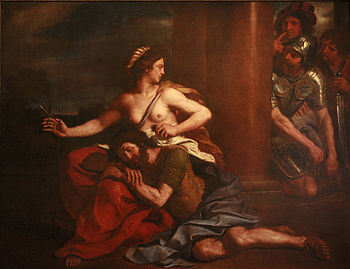 Samson fell in love with a woman named Delilah
, who lived in the valley of Sorek. The
Philistine chiefs called on her,
wanting her to coax from him the secret of his great strength, and how he might be captured and bound. "If you do this for us, we'll each give you eleven hundred silver shekels."
So she asked Samson: "Tell me where your great strength comes from - what it would take to bind you and make you captive." He replied: "
If I were tied up with seven new bowstrings I'd lose my strength and be like any other man." The Philistines brought her the bowstrings and she tied him up with them. She had men hidden in another room, and she called out: "The Philistines have come for you, Samson!" He snapped the bowstrings just as a thread breaks when fire touches it. So they remained ignorant of the secret of his strength. She said to him, "Look, you're playing games with me, you're lying to me. Now tell me how you can be tied up." So he told her, "
If they bind me with new ropes that have never been used, I'll be as helpless as anybody else." So Delilah tied him with new ropes. Then she called out: "The Philistines have come for you, Samson!" And the men were lying in wait in the other room. But he snapped the ropes off his arms like thread. Delilah said to Samson, "You are still making fun of me, telling me lies. Tell me how you can be bound!" "Well," he said, "
if you weave my seven locks of hair into a loom, and fasten them with a peg, I'll be as weak as other men." She soothed him to sleep, took his locks of hair and wove them into the loom, and then shouted: "The Philistines have come for you, Samson!" But he woke up and pulled his hair loose. Delilah said to him, "How can you say you love me when you obviously don't trust me? Three times now you have you have made a fool of me!" She kept on at him day after day. He got so sick of her nagging that in the end he told her
the truth:
"No razor has ever touched my head, because I have been a Nazirite, dedicated to God from birth. If my head were shaved my strength would leave me and I would be no different from others.
" Delilah realised that this time he had told her the truth. She summoned the Philistines one more time. They came bringing the money.
She lulled Samson to sleep in her lap, and called in a man to cut off his seven locks of hair - and his strength left him. Then she called out: "The Philistines have come for you, Samson!" He awoke from sleep, imagining he could get loose and escape as always before. He did not realise that Yahweh had turned away from him.
The Philistines seized him, gouged out his eyes,
and took him down to Gaza.
They shackled him with bronze chains, and put him to work turning the mill in the prison. But the hair that had been shorn off began to grow again.
A
femme fatale is a stock character of a mysterious and seductive woman whose charms ensnare her lovers, often
leading them into compromising, dangerous, and deadly situations.
Delilah is a character in the Hebrew bible
Book of Judges, where she is the "woman in the valley of Sorek" whom
Samson loved, and
who was his downfall.
John Milton (9 December 1608 – 8 November 1674) was an
English poet,
polemicist,
man of letters, and
a civil servant for the Commonwealth of England under Oliver Cromwell. He wrote at a time of religious flux and political upheaval, and
is best known for his epic poem Paradise Lost (1667), written in blank verse.
Milton's poetry and prose reflect deep personal convictions,
a passion for freedom and self-determination, and the urgent issues and political turbulence of his day.
Paradise Lost
 Paradise Lost
 is an epic poem in blank verse by the 17th-century English poet John Milton (1608–1674). The first version, published in 1667, consisted of ten books with over ten thousand lines of verse.
The poem concerns
the Biblical story of the Fall of Man: the temptation of
Adam and Eve by the
fallen angel Satan and their expulsion from the
Garden of Eden. Milton's purpose, stated in Book I, is to
"justify the ways of God to men".
Satan is a figure appearing in the texts of the
Abrahamic religions who brings
evil and temptation, and is known as the deceiver who leads humanity astray. Some religious groups teach that he originated as
an angel who fell out of favor with God, seducing humanity into the ways of
sin, and who has power in the fallen world. In the
Hebrew Bible and the
New Testament,
Satan is primarily an accuser and adversary, a decidedly malevolent entity, also called the devil, who possesses demonic qualities.
Lucifer has become a by-word for Satan/the Devil in the church and in popular literature",
as in
Dante Alighieri's Inferno and
John Milton's Paradise Lost.
Prince of Darkness is a term used
in John Milton's poem Paradise Lost referring to Satan as the embodiment of evil. It is an English translation of the Latin phrase
princeps tenebrarum.
Dante Alighieri
A major Italian poet of the late Middle Ages. His
Divine Comedy, originally called
Comedìa (modern Italian:
Commedia) and later christened
Divina by Boccaccio, is widely considered the greatest literary work
composed in the Italian language and
a masterpiece of world literature.
Divine Comedy
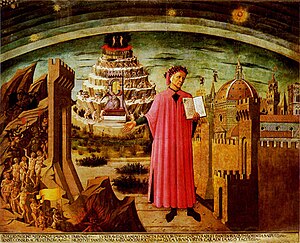 An epic poem by Dante Alighieri
, begun c. 1308 and completed 1320, a year before his death in 1321. It is widely considered the preeminent work of Italian literature and is seen as
one of the greatest works of world literature. The poem's imaginative vision of the afterlife is representative of the medieval world-view as it had developed in the Western Church by the 14th century. It helped establish the Tuscan language, in which it is written, as the standardized Italian language.
It is divided into three parts:
Inferno,
Purgatorio, and
Paradiso.
On the surface, the poem
describes Dante's travels through Hell, Purgatory, and Paradise or Heaven but at a deeper level, it represents, allegorically, the soul's journey towards God.
At this deeper level, Dante draws on medieval Christian theology and philosophy, especially Thomistic philosophy and the
Summa Theologica of Thomas Aquinas.
Consequently, the
Divine Comedy has been called "
the Summa in verse".
Inferno is the
first part of Divine Comedy. It is an
allegory telling of the journey of Dante through Hell, guided by the Roman poet
Virgil. In the
Divine Comedy,
Inferno describes the recognition and rejection of sin.

The poem starts on Maundy Thursday in the year 1300. The narrator, Dante himself, is thirty-five years old, and thus "halfway along our life's path" – half of the Biblical lifespan of seventy
The poet finds himself lost in a dark wood in front of a mountain, assailed by three beasts (
a lion,
a lonza, and
a she-wolf) he cannot evade. Unable to find the "straight way" ( also translatable as "right way") to salvation, he is conscious that he is ruining himself and falling into a "deep place" where the sun is silent .
Dante is at last rescued by the Roman poet Virgil, who claims to have been sent by Beatrice, and the two of them begin their journey to the underworld.
Each sin's punishment in Inferno is a contrapasso, a symbolic instance of poetic justice; for example, fortune-tellers have to walk forward with their heads on backward, unable to see what is ahead, because they tried to see the future through forbidden means. Such a
contrapasso "functions not merely as a form of divine revenge, but rather as the fulfilment of a destiny freely chosen by each soul during his or her life."
Dante passes through the gate of Hell, which bears an inscription ending with the famous phrase "
Lasciate ogne speranza, voi ch'intrate", most frequently translated as
"Abandon all hope, ye who enter here."
 An American author of thriller fiction
 who is best known for the 2003 bestselling novel
The Da Vinci Code.
Brown's novels are treasure hunts set in a 24-hour period,
and feature the recurring themes of cryptography, keys, symbols, codes, and conspiracy theories. His books have been translated into 52 languages, and as of 2012, sold over 200 million copies. Three of them,
Angels & Demons (2000),
The Da Vinci Code (2003), and
Inferno (2013), have been/are being adapted into films.
Inferno is a 2013
mystery thriller novel by American author
Dan Brown and the fourth book in his Robert Langdon series.
The New York Times praised the book as being "
jampacked with tricks" and said that Langdon is on "one of those book-length scavenger hunts that Mr. Brown creates so energetically." The New York
Daily News reviewed the book favorably, calling it a book of
"harrowing fun threaded with coded messages, art history, science, and imminent doom."
 Purgatorio
 is
the second part of Dante's Divine Comedy. The poem was written in the early 14th century. It is an
allegory telling of the climb of Dante up
the Mount of Purgatory, guided by the
Roman poet Virgil, except for the last four cantos at which point Beatrice takes over as Dante's guide. In the poem, Purgatory is depicted as a mountain in the
Southern Hemisphere, consisting of a bottom section (Ante-Purgatory),
seven levels of suffering and spiritual growth (associated with the seven deadly sins), and finally
the Earthly Paradise at the top. Allegorically, the poem represents the Christian life, and in describing the climb Dante discusses
the nature of sin,
examples of vice and virtue, as well as
moral issues in politics and in the Church. The poem outlines a theory that
all sin arises from love – either perverted love directed towards others' harm, or deficient love, or the disordered or excessive love of good things.
*
Seven deadly sin
A Western religious grouping and classification of
vices. The sins have fluctuated over time, the currently recognized list includes
pride,
greed,
lust,
envy,
gluttony,
wrath and
sloth. There is a parallel tradition of
seven virtues.
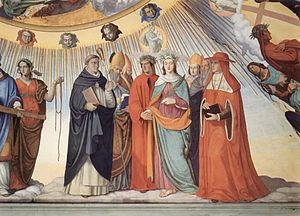 Paradiso
 is
the third and final part of Dante's Divine Comedy. It is an
allegory telling of Dante's journey through Heaven,
guided by Beatrice, who symbolises theology. In the poem, Paradise is depicted as
a series of concentric spheres surrounding the Earth, consisting of the Moon, Mercury, Venus, the Sun, Mars, Jupiter, Saturn, the Fixed Stars, the Primum Mobile and finally, the Empyrean. It was written in the early 14th century. Allegorically,
the poem represents the soul's ascent to God.
Book of Exodus
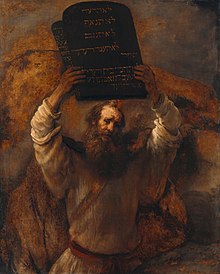
Moses was born in a time when his people, the
Israelites, an enslaved minority, were increasing in numbers and
the Egyptian Pharaoh was worried that they might ally with Egypt's enemies. Moses' Hebrew mother,
Jochebed, secretly hid him when the Pharaoh ordered all newborn Hebrew boys to be killed in order to reduce the population of the Israelites. Through the Pharaoh's daughter (identified as Queen
Bithia in the
Midrash), the child was adopted as a
foundling from the
Nile river and
grew up with the Egyptian royal family. After killing an Egyptian slavemaster (because the slavemaster was smiting a Hebrew),
Moses fled across the Red Sea to Midian, where he encountered
the God of Israel speaking to him from within a "
burning bush which was not consumed by the fire" on Mount Horeb (which he regarded as the Mountain of God).
God sent Moses back to Egypt to demand the release of the Israelites from slavery. Moses said that he could not speak with assurance or eloquence, so God allowed
Aaron, his brother, to become his spokesperson. After the
Ten Plagues,
Moses led the Exodus of the Israelites out of Egypt and across the Red Sea, after which they based themselves at
Mount Sinai, where Moses received the
Ten Commandments. After 40 years of wandering in the desert, Moses died within sight of the
Promised Land.
Burning bush

The
burning bush is an object described by the
Book of Exodus as being located on
Mount Horeb. According to the narrative, the bush was on fire, but was not consumed by the flames, hence the name.
In the biblical narrative, the burning bush is
the location at which Moses was appointed by Yahweh (God) to lead the Israelites out of Egypt and into Canaan.
The Hebrew word used in the narrative, that is translated into English as
bush, is
seneh, which refers in particular to
brambles;
seneh is a biblical
dis legomenon, only appearing in two places, both of which describe the
burning bush. It is possible that the reference to
a burning bush is based on a mistaken interpretation of Sinai , a mountain described by the Bible as being on fire.
Another possibility is that the use of
seneh may be a deliberate pun on
Sinai , a feature common in Yahwistic texts.
In the narrative, an
angel of the Lord is described as appearing in the bush, and God is subsequently described as
calling out from it to Moses, who had been grazing
Jethro's flocks there.
When Moses starts to approach, God tells Moses to take off his sandals first, due to the place being holy ground, and Moses hides his face.
Plagues of Egypt

The
Plagues of Egypt, also called the
ten biblical plagues, were
ten calamities that, according to the
biblical Book of Exodus, the
God of Israel inflicted upon
Egypt to persuade the
Pharaoh to
release the ill-treated Israelites from slavery. Pharaoh capitulated after the tenth plague, triggering
the Exodus of the Hebrew people. The plagues served to contrast the power of the God of Israel with the Egyptian gods, invalidating them. Some commentators have associated
several of the plagues with judgment on specific gods associated with the Nile, fertility and natural phenomena. According to
Exodus 12:12, all the gods of Egypt would be judged through the tenth and final plague: "On that same night I will pass through Egypt and strike down every firstborn of both people and animals, and I will bring judgment on all the gods of Egypt. I am the L
ORD."
The first three plagues seemed to affect "all the land of Egypt", while the 4th, 5th, 6th, 7th, and 9th did not affect the children of Israel. Conditions of
the 8th plague are unclear. For
the last plague, the Torah indicates that they were only spared from the final plague by
sacrificing the
Paschal lamb,
marking their place directly above their doors with the lamb's blood, and
eating the roasted sacrifice together with Matzot in a celebratory feast. The Torah describes God as actually passing through Egypt to kill all firstborn children and cattle, but passing over (hence "
Passover") houses which have the sign of lambs' blood on the doorpost.
It is debated whether it was actually God who came through the streets or one of his angels. Some also think it may be the Holy Spirit. It is most commonly known as the "
Angel of Death".
The night of this plague, Pharaoh finally relents and sends the Israelites away under their terms.
An edible substance that, according to the Bible and the Qura,
God provided for the Israelites during their travels in the desert.
In the Hebrew Bible, manna is described twice: once in
Exodus 16:1-36 with the full narrative surrounding it, and once again in
Numbers 11:1-9as a part of a separate narrative.In the description in the
Book of Exodus, manna is described as being
"a fine, flake-like thing" like the frost on the ground. Exodus adds that manna was comparable to hoarfrost in size,
similarly had to be collected before it was melted by the heat of the sun, and was white like coriander seed.
Passover
An important, biblically derived
Jewish festival. The Jewish people celebrate Passover as
a commemoration of their liberation by God from slavery in Egypt and their freedom as a nation under the leadership of Moses. It commemorates the story of the Exodus as described in the Hebrew Bible especially in
the Book of Exodus, in which
the Israelites were freed from slavery in Egypt. According to standard biblical chronology, this event would have taken place at about 1300 BCE
Ten Commandment
The
Ten Commandments, also known as the
Decalogue, are a set of commandments which the Bible describes as having
been given to the Israelites by God at biblical Mount Sinai. The Ten Commandments are listed twice in the Hebrew Bible, first at
Exodus 20:1–17, and then at
Deuteronomy 5:4–21. Both versions state that God inscribed them on two stone tablets, which he gave to Moses. According to New Testament writers,
the Ten Commandments are clearly attributed to Moses (
Mark 7:10, see also
John 7:19).
Modern scholarship has found likely influences in Hittite and Mesopotamian laws and treaties, but is divided over exactly when the Ten Commandments were written and who wrote them.
The commandments include instructions to
worship only God, to
honour parents, and to
keep the sabbath; as well as prohibitions against
idolatry,
blasphemy,
murder,
adultery,
theft,
dishonesty, and
coveting. Different religious groups follow different traditions for interpreting and numbering them.
Allegory / Fable / Parable
Allegory
As a
literary device, an
allegory in its most general sense is an extended
metaphor.Writers or speakers typically use allegories as
literary devices or as
rhetorical devices that
convey hidden meanings through
symbolic figures, actions, imagery, and/or events, which together create the moral, spiritual, or political meaning the author wishes to convey.
One of the best-known examples of allegory,
Plato's
Allegory of the Cave, forms a part of his larger work
The Republic.
Fable
A literary genre: a succinct fictional story, in prose or verse, that features animals, mythical creatures, plants, inanimate objects, or forces of nature that are anthropomorphized (given human qualities, such as verbal communication) and that illustrates or leads to an interpretation of a moral lesson (a "moral"), which may at the end be added explicitly as a pithy maxim.
Parable
A succinct, didactic story, in
prose or
verse, which illustrates one or more instructive lessons or principles. It differs from a
fable in that fables employ animals, plants, inanimate objects, or forces of nature as characters, whereas
parables have human characters.
A parable is a type of
analogy.
para-: side by side
parallel (v.)
be equivalent to
example: They parallel with one another.
paragraph (n.)
a distinct portion of written or printed matter dealing with a particular idea, usually beginning with an indentation on a new line
example: Don't omit this paragraph when you write your report.
parasol (n.)
a lightweight umbrella used, especially by women, as a sunshade
example: Cindy bought a pretty parasol for me.
parachute (n.)
a folding, umbrellalike, fabric device with cords supporting a harness or straps for allowing a person, object, package, etc., to float down safely through the air from a great height
example: When his parachute failed he thought he was a goner.

 Samson fell in love with a woman named Delilah, who lived in the valley of Sorek. The Philistine chiefs called on her, wanting her to coax from him the secret of his great strength, and how he might be captured and bound. "If you do this for us, we'll each give you eleven hundred silver shekels."
 Paradise Lost is an epic poem in blank verse by the 17th-century English poet John Milton (1608–1674). The first version, published in 1667, consisted of ten books with over ten thousand lines of verse.
 An epic poem by Dante Alighieri, begun c. 1308 and completed 1320, a year before his death in 1321. It is widely considered the preeminent work of Italian literature and is seen as one of the greatest works of world literature. The poem's imaginative vision of the afterlife is representative of the medieval world-view as it had developed in the Western Church by the 14th century. It helped establish the Tuscan language, in which it is written, as the standardized Italian language. It is divided into three parts: Inferno, Purgatorio, and Paradiso.
 The poem starts on Maundy Thursday in the year 1300. The narrator, Dante himself, is thirty-five years old, and thus "halfway along our life's path" – half of the Biblical lifespan of seventy The poet finds himself lost in a dark wood in front of a mountain, assailed by three beasts (a lion, a lonza, and a she-wolf) he cannot evade. Unable to find the "straight way" ( also translatable as "right way") to salvation, he is conscious that he is ruining himself and falling into a "deep place" where the sun is silent .
 Purgatorio is the second part of Dante's Divine Comedy. The poem was written in the early 14th century. It is an allegory telling of the climb of Dante up the Mount of Purgatory, guided by the Roman poet Virgil, except for the last four cantos at which point Beatrice takes over as Dante's guide. In the poem, Purgatory is depicted as a mountain in the Southern Hemisphere, consisting of a bottom section (Ante-Purgatory), seven levels of suffering and spiritual growth (associated with the seven deadly sins), and finally the Earthly Paradise at the top. Allegorically, the poem represents the Christian life, and in describing the climb Dante discusses the nature of sin, examples of vice and virtue, as well as moral issues in politics and in the Church. The poem outlines a theory that all sin arises from love – either perverted love directed towards others' harm, or deficient love, or the disordered or excessive love of good things.
 Paradiso is the third and final part of Dante's Divine Comedy. It is an allegory telling of Dante's journey through Heaven, guided by Beatrice, who symbolises theology. In the poem, Paradise is depicted as a series of concentric spheres surrounding the Earth, consisting of the Moon, Mercury, Venus, the Sun, Mars, Jupiter, Saturn, the Fixed Stars, the Primum Mobile and finally, the Empyrean. It was written in the early 14th century. Allegorically, the poem represents the soul's ascent to God.
 Moses was born in a time when his people, the Israelites, an enslaved minority, were increasing in numbers and the Egyptian Pharaoh was worried that they might ally with Egypt's enemies. Moses' Hebrew mother, Jochebed, secretly hid him when the Pharaoh ordered all newborn Hebrew boys to be killed in order to reduce the population of the Israelites. Through the Pharaoh's daughter (identified as Queen Bithia in the Midrash), the child was adopted as a foundling from the Nile river and grew up with the Egyptian royal family. After killing an Egyptian slavemaster (because the slavemaster was smiting a Hebrew), Moses fled across the Red Sea to Midian, where he encountered the God of Israel speaking to him from within a "burning bush which was not consumed by the fire" on Mount Horeb (which he regarded as the Mountain of God).
 The burning bush is an object described by the Book of Exodus as being located on Mount Horeb. According to the narrative, the bush was on fire, but was not consumed by the flames, hence the name.
.jpg)


 The second major part of the Christian biblical canon, the first part being the Old Testament, based on the Hebrew Bible. The Greek New Testament discusses the teachings and person of Jesus, as well as events in first-century Christianity. Christians regard both the Old and New Testaments together as sacred scripture. The New Testament (in whole or in part) has frequently accompanied the spread of Christianity around the world. It reflects and serves as a source for Christian theology and morality. Both extended readings and phrases directly from the New Testament are also incorporated (along with readings from the Old Testament) into the various Christian liturgies. The New Testament has influenced religious, philosophical, and political movements in Christendom, and left an indelible mark on literature, art, and music.

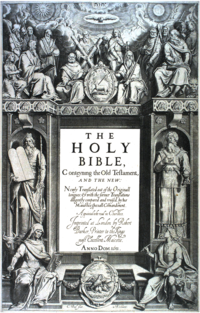 An English translation of the Christian Bible for the Church of England that begun in 1604 and completed in 1611.
 Adam knew his wife Eve intimately, and she conceived and bore Cain. She said, "I have had a male child with the Lord's help."
 God makes a pledge of commitment to Noah in Genesis 9:1–17. The priestly (Elohim) version takes the form of a covenant arrangement. This is the first explicit act of a covenant in the Hebrew Bible and is used seven times in this episode. God commits to continue both human and animal life and vows to never again use a deluge against humanity. The covenant is sealed with the sign of a rainbow, after a storm, as a reminder.
 The storm cleared, and after a hundred and fifty days the waters of the flood were gone. The mountains again were seen, and the ark rested on the mountain tops. Noah opened the window of the ark and sent out birds, first a raven and then a dove, to see if the waters had gone. The raven, a big black bird with a harsh voice, flew back and forth over the waters until they dried up. The dove when first sent out found no place to light, and came back to Noah in the evening. The next time she brought back an olive leaf in her mouth. And the third time she did not come back, for the ground was dry. Then Noah uncovered the ark and the people and the animals from the ark came out to find happy homes. Noah worshiped; the Lord was pleased with his worship and promised that there should not again be a flood to destroy all things.
_-_Google_Art_Project_-_edited.jpg)
 The Bible is a collection of texts sacred in Judaism and Christianity. It is a collection of scriptures written at different times by different authors in different locations. Jews and Christians consider the books of the Bible to be a product of divine inspiration or an authoritative record of the relationship between God and humans.
.jpg)

 An English writer and social critic. He created some of the world's best-known fictional characters and is regarded as the greatest novelist of the Victorian era. His works enjoyed unprecedented popularity during his lifetime, and by the twentieth century critics and scholars had recognised him as a literary genius. His novels and short stories enjoy lasting popularity.
 A Christmas Carol in Prose, Being a Ghost-Story of Christmas, commonly known as A Christmas Carol, is a novella by Charles Dickens, first published in London by Chapman & Hall on 19 December 1843. The novella met with instant success and critical acclaim. A Christmas Carol tells the story of a bitter old miser named Ebenezer Scrooge and his transformation into a gentler, kindlier man after visitations by the ghost of his former business partner Jacob Marley and the Ghosts of Christmas Past, Present and Yet to Come.
 David Coperfeild is the eighth novel by Charles Dickens. It was first published as a serial in 1849–50, and as a book in 1850. Many elements of the novel follow events in Dickens' own life, and it is probably the most autobiographical of his novels. In the preface to the 1867 edition, Dickens wrote, "like many fond parents, I have in my heart of hearts a favourite child. And his name is David Copperfield."
