顯示具有 Approaches to Literature 標籤的文章。 顯示所有文章

2016年6月14日 星期二

Approaches to Literature(Week16)

  • The Midsummer Night's Dream

Summary:

Theseus, duke of Athens, is preparing for his marriage to Hippolyta, queen of the Amazons, with a four-day festival of pomp and entertainment. He commissions his Master of the Revels, Philostrate, to find suitable amusements for the occasion. Egeus, an Athenian nobleman, marches into Theseus’s court with his daughter, Hermia, and two young men, Demetrius and Lysander. Egeus wishes Hermia to marry Demetrius (who loves Hermia), but Hermia is in love with Lysander and refuses to comply. Egeus asks for the full penalty of law to fall on Hermia’s head if she flouts her father’s will. Theseus gives Hermia until his wedding to consider her options, warning her that disobeying her father’s wishes could result in her being sent to a convent or even executed. Nonetheless, Hermia and Lysander plan to escape Athens the following night and marry in the house of Lysander’s aunt, some seven leagues distant from the city. They make their intentions known to Hermia’s friend Helena, who was once engaged to Demetrius and still loves him even though he jilted her after meeting Hermia. Hoping to regain his love, Helena tells Demetrius of the elopement that Hermia and Lysander have planned. At the appointed time, Demetrius stalks into the woods after his intended bride and her lover; Helena follows behind him.
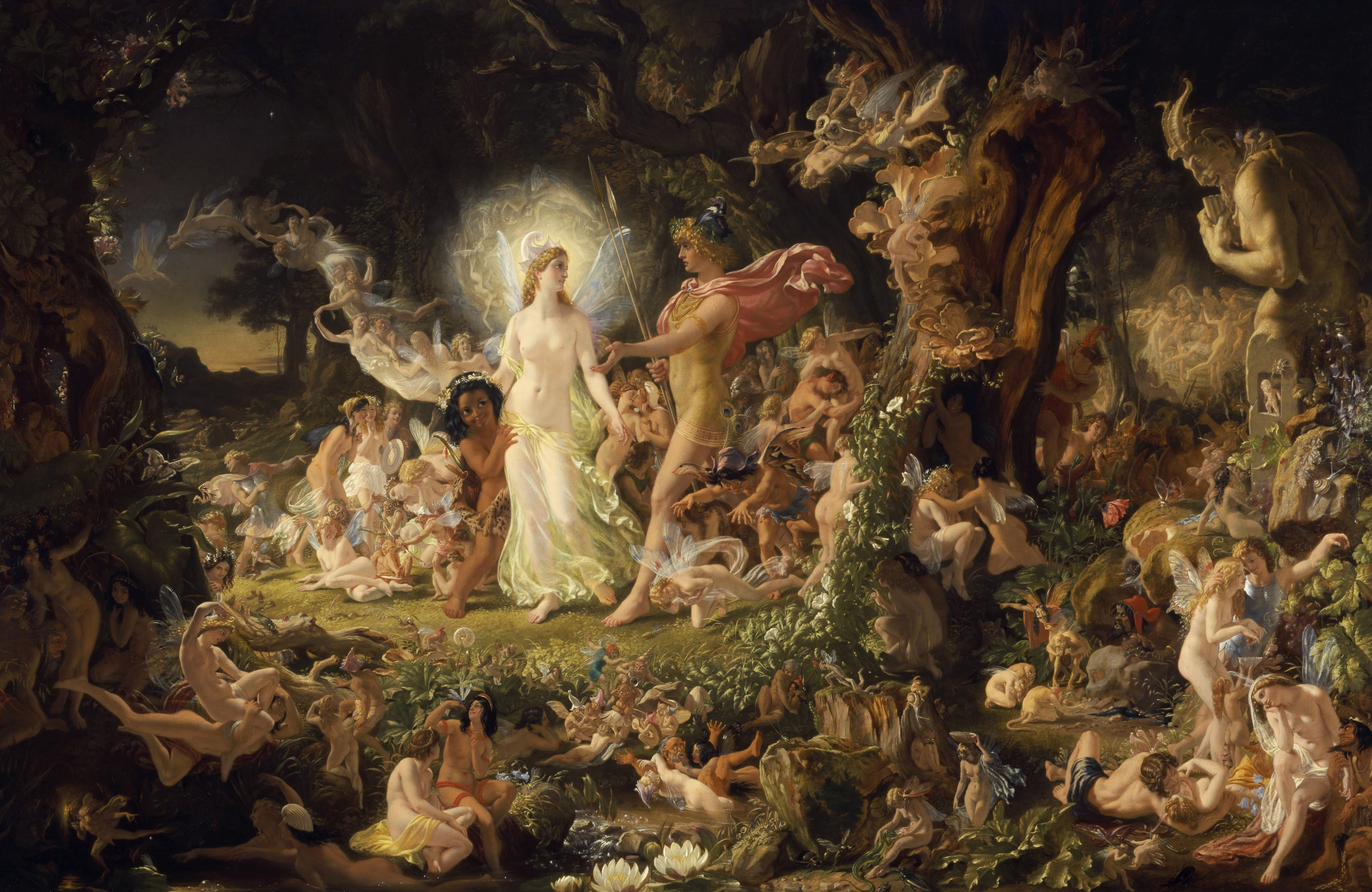
In these same woods are two very different groups of characters. The first is a band of fairies, including Oberon, the fairy king, and Titania, his queen, who has recently returned from India to bless the marriage of Theseus and
 Hippolyta. The second is a band of Athenian craftsmen rehearsing a play that they hope to perform for the duke and his bride. Oberon and Titania are at odds over a young Indian prince given to Titania by the prince’s mother; the boy is so beautiful that Oberon wishes to make him a knight, but Titania refuses. Seeking revenge, Oberon sends his merry servant, Puck, to acquire a magical flower, the juice of which can be spread over a sleeping person’s eyelids to make that person fall in love with the first thing he or she sees upon waking. Puck obtains the flower, and Oberon tells him of his plan to spread its juice on the sleeping Titania’s eyelids. Having seen Demetrius act cruelly toward Helena, he orders Puck to spread some of the juice on the eyelids of the young Athenian man. Puck encounters Lysander and Hermia; thinking that Lysander is the Athenian of whom Oberon spoke, Puck afflicts him with the love potion. Lysander happens to see Helena upon awaking and falls deeply in love with her, abandoning Hermia. As the night progresses and Puck attempts to undo his mistake, both Lysander and Demetrius end up in love with Helena, who believes that they are mocking her. Hermia becomes so jealous that she tries to challenge Helena to a fight. Demetrius and Lysander nearly do fight over Helena’s love, but Puck confuses them by mimicking their voices, leading them apart until they are lost separately in the forest.
When Titania wakes, the first creature she sees is Bottom, the most ridiculous of the Athenian craftsmen, whose head Puck has mockingly transformed into that of an ass. Titania passes a ludicrous interlude doting on the ass-headed weaver. Eventually, Oberon obtains the Indian boy, Puck spreads the love potion on Lysander’s eyelids, and by morning all is well. Theseus and Hippolyta discover the sleeping lovers in the forest and take them back to Athens to be marriedDemetrius now loves Helena, and Lysander now loves Hermia. After the group wedding, the lovers watch Bottom and his fellow craftsmen perform their play, a fumbling, hilarious version of the story of Pyramus and Thisbe. When the play is completed, the lovers go to bed; the fairies briefly emerge to bless the sleeping couples with a protective charm and then disappear. Only Puck remains, to ask the audience for its forgiveness and approval and to urge it to remember the play as though it had all been a dream.


>> "Love looks not with the eyes, but with the mind"

Helena: "Love looks not with the eyes but with the mind."

In this soliloquy, Helena ponders the transforming power of love, noting that Cupid is blind. The lovesick Helena has been abandoned by her beloved Demetrius, because he loves the more attractive Hermia. Helena, while tall and fair, is not as lovely as Hermia. Helena finds it unfair that Demetrius dotes on Hermia's beauty, and she wishes appearances were contagious the way a sickness is so that she might look just like Hermia and win back Demetrius. The connection of love to eyesight and vision are matters of vital importance in this play about love and the confusion it sometimes brings.

  • What is literature for?


  • Amendment

An amendment is a formal or official change made to a law, contract, constitution, or other legal document. It is based on the verb to amend, which means to change. Amendments can add, remove, or update parts of these agreements. They are often used when it is better to change the document than to write a new one.
 

>> Thirteenth Amendment to the United States Constitution

Greater coat of arms of the United States.svg
 
The Thirteenth Amendment (Amendment XIII) to the United States Constitution abolished slavery and involuntary servitude, except as punishment for a crime. In Congress, it was passed by the Senate on April 8, 1864, and by the House on January 31, 1865. The amendment was ratified by the required number of states on December 6, 1865. On December 18, 1865, Secretary of State William H. Seward proclaimed its adoption. It was the first of the three Reconstruction Amendments adopted following the American Civil War.
Slavery had been tacitly enshrined in the original Constitution through provisions such as Article I, Section 2, Clause 3, commonly known as the Three-Fifths Compromise, which detailed how each state's total slave population would be factored into its total population count for the purposes of apportioning seats in the United States House of Representatives and direct taxes among the states. Though many slaves had been declared free by President Abraham Lincoln's 1863 Emancipation Proclamation, their post-war status was uncertain. On April 8, 1864, the Senate passed an amendment to abolish slavery. After one unsuccessful vote and extensive legislative maneuvering by the Lincoln administration, the House followed suit on January 31, 1865. The measure was swiftly ratified by nearly all Northern states, along with a sufficient number of border and "reconstructed" Southern states, to cause it to be adopted before the end of the year.
Though the amendment formally abolished slavery throughout the United States, factors such as Black Codes, white supremacist violence, and selective enforcement of statutes continued to subject some black Americans to involuntary labor, particularly in the South. In contrast to the other Reconstruction Amendments, the Thirteenth Amendment was rarely cited in later case law, but has been used to strike down peonage and some race-based discrimination as "badges and incidents of slavery". The Thirteenth Amendment applies to the actions of private citizens, while the Fourteenth and Fifteenth Amendments apply only to state actors. The amendment also enables Congress to pass laws against sex trafficking and other modern forms of slavery.
 
  • Magic mirror

The Magic Mirror is a mystical object that is featured in the story of Snow White.
 
 
The Magic Mirror is owned by the Evil Queen and has been depicted in different versions as either a hand mirror or a mirror on the wall. Every morning, the Evil Queen asked the Magic Mirror the question "Magic mirror in my hand, who is the fairest in the land?". The mirror always replies: "My Queen, you are the fairest in the land." The Queen is always pleased with that, because the magic mirror never lies. But, when Snow White reaches the age of seven, she becomes as beautiful as the day and even more beautiful than the Queen and when the Queen asks her mirror, it responds: "My Queen, you are the fairest here so true. But Snow White is a thousand times more beautiful than you." This resulted in the Evil Queen enlisting a huntsman to kill Snow White and bring her Snow White's lungs and liver. After eating the lungs and liver of a boar that the Huntsman passed off as Snow White's lungs and liver, the Evil Queen asked the Magic Mirror the question "Magic Mirror in my hand, who is the fairest in the land?" The mirror replies: "My Queen, you are the fairest here so true. But Snow White beyond the mountains at the seven Dwarfs is a thousand times more beautiful than you." This caused the Evil Queen to disguise herself as different women to kill Snow White. After the latest attempt with a poison apple which was undone by the Prince and Snow White marrying him, the Evil Queen asked the Magic Mirror who the fairest in the land was, the Magic Mirror quoted "You, my Queen, are fair so true. But the young Queen is a thousand times fairer than you." The Evil Queen learned too late at the wedding that the young queen in question was Snow White which eventually leads to the Queen's death which varied per version.

Approaches to Literature(Week15)

  • Demi god

A demigod or demi-god is a divine or supernatural being in classical mythology. The term has been used in various ways at different times and can refer to a figure who has attained divine status after death, a minor deity, or a mortal who is the offspring of a god and a human being.

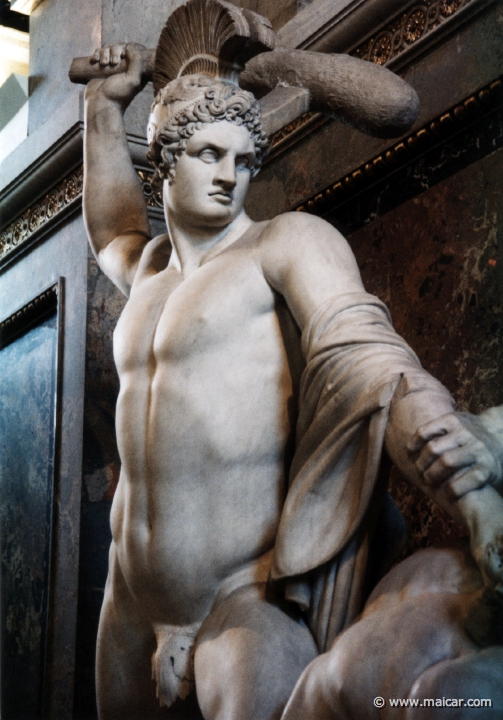
>> Theseus

Theseus  was the mythical king of Athens and was the son of Aethra by two fathers: Aegeus and Poseidon.
Theseus was a founder-hero, like Perseus, Cadmus, or Heracles (Hercules), all of whom battled and overcame foes that were identified with an archaic religious and social order. As Heracles was the Dorian hero, Theseus was a founding hero, considered by Athenians as their own great reformer: his name comes from the same root as θεσμός ("thesmos"), Greek for "The Gathering". The myths surrounding Theseus—his journeys, exploits, and family—have provided material for fiction throughout the ages.
Theseus was responsible for the synoikismos ("dwelling together")—the political unification of Attica under Athens, represented emblematically in his journey of labours, subduing ogres and monstrous beasts. Because he was the unifying king, Theseus built and occupied a palace on the fortress of the Acropolis that may have been similar to the palace that was excavated in Mycenae. Pausanias reports that after the synoikismos, Theseus established a cult of Aphrodite Pandemos ("Aphrodite of all the People") and Peitho on the southern slope of the Acropolis.
Plutarch's vita (a literalistic biography) of Theseus makes use of varying accounts of the death of the Minotaur, Theseus' escape, and the love of Ariadne for Theseus. Plutarch's sources, not all of whose texts have survived independently, included Pherecydes (mid-fifth century BC), Demon (c. 400 BC), Philochorus, and Cleidemus (both fourth century BC).

>> Hercules

Hercules is the Roman name for the Greek divine hero Heracles, who was the son of Zeus (Roman equivalent Jupiter) and the mortal Alcmene. In classical mythology, Hercules is famous for his strength and for his numerous far-ranging adventures.
The Romans adapted the Greek hero's iconography and myths for their literature and art under the name Hercules. In later Western art and literature and in popular culture, Hercules is more commonly used than Heracles as the name of the hero. Hercules was a multifaceted figure with contradictory characteristics, which enabled later artists and writers to pick and choose how to represent him. This article provides an introduction to representations of Hercules in the later tradition.

Hercules is known for his many adventures, which took him to the far reaches of the Greco-Roman world. One cycle of these adventures became canonical as the "Twelve Labours," but the list has variations.


  • Eros

 
In Greek mythology, Eros  was the Greek god of love. His Roman counterpart was Cupid ("desire"). Some myths make him a primordial god, while in other myths, he is the son of Aphrodite. He was one of the winged love gods, Erotes.
Eros appears in ancient Greek sources under several different guises. In the earliest sources (the cosmogonies, the earliest philosophers, and texts referring to the mystery religions), he is one of the primordial gods involved in the coming into being of the cosmos. But in later sources, Eros is represented as the son of Aphrodite, whose mischievous interventions in the affairs of gods and mortals cause bonds of love to form, often illicitly. Ultimately, in the later satirical poets, he is represented as a blindfolded child, the precursor to the chubby Renaissance Cupid, whereas in early Greek poetry and art, Eros was depicted as an adult male who embodies sexual power, and a profound artist.
A cult of Eros existed in pre-classical Greece, but it was much less important than that of Aphrodite. However, in late antiquity, Eros was worshiped by a fertility cult in Thespiae. In Athens, he shared a very popular cult with Aphrodite, and the fourth day of every month was sacred to him

  • A Midsummer Night's Dream

A Midsummer Night's Dream is a comedy written by William Shakespeare sometime between 1590 and 1597. It portrays the events surrounding the marriage of Theseus, the Duke of Athens, to Hippolyta. These include the adventures of four young Athenian lovers and a group of six amateur actors (the mechanicals) who are controlled and manipulated by the fairies who inhabit the forest in which most of the play is set. The play is one of Shakespeare's most popular works for the stage and is widely performed across the world.


2016年6月9日 星期四

Approaches to Literature(Week14)

  • "Dover Beach"

"Dover Beach" is a lyric poem by the English poet Matthew Arnold. It was first published in 1867 in the collection New Poems, but surviving notes indicate its composition may have begun as early as 1849. The most likely date is 1851.
The title, locale and subject of the poem's descriptive opening lines is the shore of the English ferry port of Dover, Kent, facing Calais, France, at the Strait of Dover, the narrowest part (21 miles) of the English Channel, where Arnold honeymooned in 1851.

>> Matthew Arnold

Matthew Arnold.jpg
 
Matthew Arnold (24 December 1822 – 15 April 1888) was an English poet and cultural critic who worked as an inspector of schools. He was the son of Thomas Arnold, the famed headmaster of Rugby School, and brother to both Tom Arnold, literary professor, and William Delafield Arnold, novelist and colonial administrator. Matthew Arnold has been characterised as a sage writer, a type of writer who chastises and instructs the reader on contemporary social issues.
His 1867 poem, "Dover Beach," depicted a nightmarish world from which the old religious verities have receded. It is sometimes held up as an early, if not the first, example of the modern sensibility. In a famous preface to a selection of the poems of William Wordsworth, Arnold identified, a little ironically, as a "Wordsworthian." The influence of Wordsworth, both in ideas and in diction, is unmistakable in Arnold's best poetry. Arnold's poem, "Dover Beach" was included in Ray Bradbury's novel, Fahrenheit 451, and is also featured prominently in the novel Saturday by Ian McEwan. It has also been quoted or alluded to in a variety of other contexts.
Some consider Arnold to be the bridge between Romanticism and Modernism. His use of symbolic landscapes was typical of the Romantic era, while his sceptical and pessimistic perspective was typical of the Modern era. The rationalistic tendency of certain of his writings gave offence to many readers, and the sufficiency of his equipment in scholarship for dealing with some of the subjects which he handled was called in question, but he undoubtedly exercised a stimulating influence on his time. His writings are characterised by the finest culture, high purpose, sincerity, and a style of great distinction, and much of his poetry has an exquisite and subtle beauty, though here also it has been doubted whether high culture and wide knowledge of poetry did not sometimes take the place of true poetic fire. Henry James wrote that Matthew Arnold's poetry will appeal to those who "like their pleasures rare" and who like to hear the poet "taking breath."


  • "To His Coy Mistress"

"To His Coy Mistress" is a metaphysical poem written by the English author and politician Andrew Marvell (1621–1678) either during or just before the English Interregnum (1649–60).
This poem is considered one of Marvell's finest and is possibly the best recognized carpe diem poem in English. Although the date of its composition is not known, it may have been written in the early 1650s. At that time, Marvell was serving as a tutor to the daughter of the retired commander of the New Model Army, Sir Thomas Fairfax.

 
To His Coy Mistress
Had we but world enough, and time,
This coyness, Lady, were no crime
We would sit down and think which way
To walk and pass our long love's day.
Thou by the Indian Ganges' side
Shouldst rubies find: I by the tide
Of Humber would complain. I would
Love you ten years before the Flood,
And you should, if you please, refuse
Till the conversion of the Jews.
My vegetable love should grow
Vaster than empires, and more slow;
A hundred years should go to praise
Thine eyes and on thy forehead gaze;
Two hundred to adore each breast,
But thirty thousand to the rest;
An age at least to every part,
And the last age should show your heart.
For, Lady, you deserve this state,
Nor would I love at lower rate.

But at my back I always hear
Time's wingèd chariot hurrying near;
And yonder all before us lie
Deserts of vast eternity.
Thy beauty shall no more be found,
Nor, in thy marble vault, shall sound
My echoing song; then worms shall try
That long preserved virginity,
And your quaint honour turn to dust,
And into ashes all my lust:
The grave's a fine and private place,
But none, I think, do there embrace.

Now therefore, while the youthful hue
Sits on thy skin like morning dew,
And while thy willing soul transpires
At every pore with instant fires,
Now let us sport us while we may,
And now, like amorous birds of prey,
Rather at once our time devour
Than languish in his slow-chapped power.
Let us roll all our strength and all
Our sweetness up into one ball,
And tear our pleasures with rough strife
Through the iron gates of life:
Thus, though we cannot make our sun
Stand still, yet we will make him run.
 

>> Anorew Harvell

Andrew Marvell.jpg
 
Andrew Marvell (/ˈmɑːrvəl/; 31 March 1621 – 16 August 1678) was an English metaphysical poet, satirist and politician who sat in the House of Commons at various times between 1659 and 1678. During the Commonwealth period he was a colleague and friend of John Milton. His poems range from the love-song "To His Coy Mistress", to evocations of an aristocratic country house and garden in "Upon Appleton House" and "The Garden", the political address "An Horatian Ode upon Cromwell's Return from Ireland", and the later personal and political satires "Flecknoe" and "The Character of Holland".

* Hyperbole

Hyperbole is the use of exaggeration as a rhetorical device or figure of speech. In rhetoric, it is also sometimes known as auxesis (lit. "growth"). In poetry and oratory, it emphasizes, evokes strong feelings, and creates strong impressions. As a figure of speech, it is usually not meant to be taken literally.

  • "To the Virgins, to Make Much of Time"

"To the Virgins, to Make Much of Time" is a poem written by English Cavalier poet Robert Herrick in the 17th century. The poem is in the genre of carpe diem, Latin for seize the day. It goes as follows:
Gather ye rosebuds while ye may,
Old Time is still a-flying;
And this same flower that smiles today
To-morrow will be dying.
The glorious lamp of heaven, the sun,
The higher he's a-getting,
The sooner will his race be run,
And nearer he's to setting.
That age is best which is the first,
When youth and blood are warmer;
But being spent, the worse, and worst
Times still succeed the former.
Then be not coy, but use your time,
And, while ye may, go marry:
For having lost but once your prime,
You may forever tarry.

>> Robert Herrick

Robert Herrick (poet).jpg
 
Robert Herrick (baptised 24 August 1591 – buried 15 October 1674) was a 17th-century English lyric poet and cleric. He is best known for Hesperides, a book of poems. This includes the carpe diem poem "To the Virgins, to Make Much of Time", with the first line "Gather ye rosebuds while ye may".
Herrick wrote over 2,500 poems, about half of which appear in his major work, Hesperides. Hesperides also includes the much shorter Noble Numbers, his first book, of spiritual works, first published in 1647. He is well known for his style and, in his earlier works, for frequent references to lovemaking and the female body. His later poetry was more of a spiritual and philosophical nature. Among his most famous short poetical sayings are the unique monometers, such as number 475, "Thus I / Pass by / And die,/ As one / Unknown / And gone."

>> Carper diem

Carpe diem is a Latin aphorism, usually translated "seize the day", taken from book 1 of the Roman poet Horace's work Odes (23 BC).
In Horace, the phrase is part of the longer "carpe diem, quam minimum credula postero", which can be translated as "Seize the day, put very little trust in tomorrow (the future)". The ode says that the future is unforeseen and that one should not leave to chance future happenings, but rather one should do all one can today to make one's future better. This phrase is usually understood against Horace's Epicurean background. The meaning of "carpe diem" as used by Horace is not to ignore the future, but rather not to trust that everything is going to fall into place for you and taking action for the future today.

Approaches to Literature(Week13)

  • Marguerite Duras

Duras, 1993
 
Marguerite Donnadieu, known as Marguerite Duras ( 4 April 1914 – 3 March 1996), was a French novelist, playwright, scriptwriter, essayist and experimental filmmaker. She is best known for writing the 1959 film Hiroshima mon amour, which earned her a nomination for Best Original Screenplay at the Academy Awards.

>> Hiroshima mon amour

Hiroshima Mon Amour 1959.jpg
 
Hiroshima mon amour (French pronunciation: ​[iʁoʃima mɔ̃.n‿amuʁ], Hiroshima My Love; Japanese: 二十四時間の情事 Nijūyojikan'nojōji, Twenty-four-hour affair) is a 1959 drama film directed by French film director Alain Resnais, with a screenplay by Marguerite Duras. It is the documentation of an intensely personal conversation between a French-Japanese couple about memory and forgetfulness. It was a major catalyst for the Left Bank Cinema, making highly innovative use of miniature flashbacks to create a uniquely nonlinear storyline.

>> Song Sharing: 我多麼羨慕你


  • Walt Whitman

Walt Whitman - George Collins Cox.jpgWalter "Walt" Whitman (/ˈhwɪtmən/; May 31, 1819 – March 26, 1892) was an American poet, essayist, and journalist. A humanist, he was a part of the transition between transcendentalism and realism, incorporating both views in his works. Whitman is among the most influential poets in the American canon, often called the father of free verse. His work was very controversial in its time, particularly his poetry collection Leaves of Grass, which was described as obscene for its overt sexuality.
Born in Huntington on Long Island, Whitman worked as a journalist, a teacher, a government clerk, and—in addition to publishing his poetry—was a volunteer nurse during the American Civil War. Early in his career, he also produced a temperance novel, Franklin Evans (1842). Whitman's major work, Leaves of Grass, was first published in 1855 with his own money. The work was an attempt at reaching out to the common person with an American epic. He continued expanding and revising it until his death in 1892. After a stroke towards the end of his life, he moved to Camden, New Jersey, where his health further declined. When he died at age 72, his funeral became a public spectacle.

>> "Song of Myself"

Song of Myself" is a poem by Walt Whitman that is included in his work Leaves of Grass. It has been credited as "representing the core of Whitman’s poetic vision." The poem is written in Whitman's signature free verse style. Whitman, who praises words "as simple as grass" (section 39) forgoes standard verse and stanza patterns in favor of a simple, legible style that can appeal to a mass audience. 
I celebrate myself, and sing myself,
And what I assume you shall assume,
For every atom belonging to me as good belongs to you.

I loafe and invite my soul,
I lean and loafe at my ease observing a spear of summer grass.

My tongue, every atom of my blood, form'd from this soil, this air,
Born here of parents born here from parents the same, and their parents the same,
I, now thirty-seven years old in perfect health begin,
Hoping to cease not till death.

Creeds and schools in abeyance,
Retiring back a while sufficed at what they are, but never forgotten,
I harbor for good or bad, I permit to speak at every hazard,
Nature without check with original energy.
  • Emily Dickinson

Photograph of Emily Dickinson, seated, at the age of 16
Emily Elizabeth Dickinson (December 10, 1830 – May 15, 1886) was an American poet. Dickinson was born in Amherst, Massachusetts. Although part of a prominent family with strong ties to its community, Dickinson lived much of her life highly introverted. After studying at the Amherst Academy for seven years in her youth, she briefly attended the Mount Holyoke Female Seminary before returning to her family's house in Amherst. Considered an eccentric by locals, she developed a noted penchant for white clothing and became known for her reluctance to greet guests or, later in life, to even leave her bedroom. Dickinson never married, and most friendships between her and others depended entirely upon correspondence.
While Dickinson was a prolific private poet, fewer than a dozen of her nearly 1,800 poems were published during her lifetime.The work that was published during her lifetime was usually altered significantly by the publishers to fit the conventional poetic rules of the time. Dickinson's poems are unique for the era in which she wrote; they contain short lines, typically lack titles, and often use slant rhyme as well as unconventional capitalization and punctuation. Many of her poems deal with themes of death and immortality, two recurring topics in letters to her friends.

>>"A narrow Fellow in the Grass"  

A narrow fellow in the grass
Occasionally rides;
You may have met him—did you not
His notice instant is,
The grass divides as with a comb,
A spotted shaft is seen,
And then it closes at your feet,
And opens further on.

He likes a boggy acre
A floor too cool for corn,
Yet when a boy and barefoot,
I more than once at noon
Have passed, I thought, a whip lash,
Unbraiding in the sun,
When stooping to secure it,
It wrinkled and was gone.

Several of nature's people
I know, and they know me;
I feel for them a transport
Of cordiality.
Yet never met this fellow,
Attended or alone,
Without a tighter breathing,
And zero at the bone.


  • Samuel Taylor Coleridge

SamuelTaylorColeridge.jpgSamuel Taylor Coleridge ( 21 October 1772 – 25 July 1834) was an English poet, literary critic and philosopher who, with his friend William Wordsworth, was a founder of the Romantic Movement in England and a member of the Lake Poets. He wrote the poems The Rime of the Ancient Mariner and Kubla Khan, as well as the major prose work Biographia Literaria. His critical work, especially on Shakespeare, was highly influential, and he helped introduce German idealist philosophy to English-speaking culture. Coleridge coined many familiar words and phrases, including suspension of disbelief. He was a major influence on Emerson and American transcendentalism.
Throughout his adult life Coleridge had crippling bouts of anxiety and depression; it has been speculated that he had bipolar disorder, which had not been defined during his lifetime. He was physically unhealthy, which may have stemmed from a bout of rheumatic fever and other childhood illnesses. He was treated for these conditions with laudanum, which fostered a lifelong opium addiction.

>> Kubla Khan

"Kubla Khan; or, A Vision in a Dream: A Fragment" /ˌkʊblə ˈkɑːn/ is a poem written by Samuel Taylor Coleridge, completed in 1797 and published in 1816. According to Coleridge's Preface to "Kubla Khan", the poem was composed one night after he experienced an opium-influenced dream after reading a work describing Xanadu, the summer palace of the Mongol ruler and Emperor of China Kublai Khan. Upon waking, he set about writing lines of poetry that came to him from the dream until he was interrupted by a person from Porlock. The poem could not be completed according to its original 200–300 line plan as the interruption caused him to forget the lines. He left it unpublished and kept it for private readings for his friends until 1816 when, at the prompting of Lord Byron, it was published.
Some of Coleridge's contemporaries denounced the poem and questioned his story of its origin. It was not until years later that critics began to openly admire the poem. Most modern critics now view "Kubla Khan" as one of Coleridge's three great poems, along with The Rime of the Ancient Mariner and Christabel. The poem is considered one of the most famous examples of Romanticism in English poetry. A copy of the manuscript is a permanent exhibit at the British Museum in London.
  • James Dickey

James Dickey.jpg
 
James Lafayette Dickey (February 2, 1923 – January 19, 1997) was an American poet and novelist. He was appointed the eighteenth Poet Laureate Consultant in Poetry to the Library of Congress in 1966. He also received the Order of the South award.
  • Edgar Allan Poe

Edgar Allan Poe daguerreotype crop.pngEdgar Allan Poe (/p/; born Edgar Poe; January 19, 1809 – October 7, 1849) was an American writer, editor, and literary critic. Poe is best known for his poetry and short stories, particularly his tales of mystery and the macabre. He is widely regarded as a central figure of Romanticism in the United States and American literature as a whole, and he was one of the country's earliest practitioners of the short story. Poe is generally considered the inventor of the detective fiction genre and is further credited with contributing to the emerging genre of science fiction. He was the first well-known American writer to try to earn a living through writing alone, resulting in a financially difficult life and career.

>> "The Raven"


"The Raven" is a narrative poem by American writer Edgar Allan Poe. First published in January 1845, the poem is often noted for its musicality, stylized language, and supernatural atmosphere. It tells of a talking raven's mysterious visit to a distraught lover, tracing the man's slow fall into madness. The lover, often identified as being a student, is lamenting the loss of his love, Lenore. Sitting on a bust of Pallas, the raven seems to further instigate his distress with its constant repetition of the word "Nevermore". The poem makes use of a number of folk, mythological, religious, and classical references.

>> "To Helen"

"To Helen" is the first of two poems to carry that name written by Edgar Allan Poe. The 15-line poem was written in honor of Jane Stanard, the mother of a childhood friend. It was first published in 1831 collection Poems of Edgar A. Poe. It was then reprinted in 1836 in the Southern Literary Messenger.

2016年5月25日 星期三

Approaches to Literature(Week12)

  •  "Somewhere i have never travelled, gladly beyond"

 
This title has no significance other than it is the first line.

Theme- Love is the clear theme of this poem.

 Speaker-The speaker is a man who is in love and dumbfounded by it's mystery. Many believe the speaker is Cummings.

Tone- The tone of the poem is mystified by the effects love has on the speaker.

Importance to society-The poem was written during the Great Depression. Many readers were looking for happiness and love in a world focused on survival.

 Rhythm and Pattern -This poem has five verse paragraphs, displaying Cummings' signature style: odd use of punctuation and spacing, unusual word order, and other variant uses of language.

Rhyme Scheme- This poem has no specific rhyme scheme. It is a free verse poem
  •  "Anyone lived in a pretty how town" 


"anyone lived in a pretty how town" is a poem written by E. E. Cummings. First published in 1940, the poem details the lives of residents in a nameless town. Like much of Cummings's work, the poem is actually untitled, so critics use the first line to refer to the poem. Cummings often wrote in a manner that did not follow standard English syntax and punctuation. This style is evident in the poem's first line, which is written in all lowercase letters and contains the unlikely phrase "pretty how town".
The poem was adapted into a short film of the same name by George Lucas.

Style- In the poem, Cummings states the lines, "spring summer autumn winter", (3) and "sun moon stars rain", (8) multiple times. In reiterating these lines he changes the order of the seasons, "autumn winter spring summer", (11) and "stars rain sun moon", (21).
  • The canterbury tales

The Canterbury Tales (Middle English: Tales of Caunterbury) is a collection of 24 stories that runs to over 17,000 lines written in Middle English by Geoffrey Chaucer. In 1386, Chaucer became Controller of Customs and Justice of Peace and, three years later, Clerk of the King's work in 1389. It was during these years that Chaucer began working on his most famous text, The Canterbury Tales. The tales (mostly written in verse, although some are in prose) are presented as part of a story-telling contest by a group of pilgrims as they travel together on a journey from London to Canterbury in order to visit the shrine of Saint Thomas Becket at Canterbury Cathedral. The prize for this contest is a free meal at the Tabard Inn at Southwark on their return.
It is sometimes argued that the greatest contribution The Canterbury Tales made to English literature was in popularising the literary use of the vernacular, English, rather than French, Italian or Latin. English had, however, been used as a literary language centuries before Chaucer's time, and several of Chaucer's contemporaries—John Gower, William Langland, the Pearl Poet, and Julian of Norwich—also wrote major literary works in English. It is unclear to what extent Chaucer was responsible for starting a trend as opposed to simply being part of it.

>> General Prologue

 The General Prologue is the first part of Chaucer's The Canterbury Tales.
The frame story of the poem, as set out in the 858 lines of Middle English which make up the general prologue, is of a religious pilgrimage. The narrator, Geoffrey Chaucer, is in The Tabard Inn in Southwark, where he meets a group of "sundry folk" who are all on the way to Canterbury, the site of the shrine of Saint Thomas Becket.
The setting is April, and the prologue starts by singing the praises of that month whose rains and warm western wind restore life and fertility to the earth and its inhabitants. This abundance of life, the narrator says, prompts people to go on pilgrimages; in England, the goal of such pilgrimages is the shrine of Thomas Becket. The narrator falls in with a group of pilgrims, and the largest part of the prologue is taken up by a description of them; Chaucer seeks to describe their 'condition', their 'array', and their social 'degree':
To telle yow al the condicioun,
Of ech of hem, so as it semed me,
And whiche they weren, and of what degree,
And eek in what array that they were inne,
And at a knyght than wol I first bigynne.
  • Free verse

Free verse is an open form of poetry. It does not use consistent meter patterns, rhyme, or any other musical pattern. It thus tends to follow the rhythm of natural speech.
Poets have explained that free verse is not totally free; 'its only freedom is from the tyrant demands of the metered line'. Free verse displays some elements of form. Most free verse, for example, self-evidently continues to observe a convention of the poetic line in some sense, at least in written representations, though retaining a potential degree of linkage.
Although free verse requires no meter, rhyme, or other traditional poetic techniques, a poet can still use them to create some sense of structure. A clear example of this can be found in Walt Whitman's poems, where he repeats certain phrases and uses commas to create both a rhythm and structure.

    >> Walt Whitman

Walt Whitman - George Collins Cox.jpg
 
Walter "Walt" Whitman ( May 31, 1819 – March 26, 1892) was an American poet, essayist, and journalist. A humanist, he was a part of the transition between transcendentalism and realism, incorporating both views in his works. Whitman is among the most influential poets in the American canon, often called the father of free verse. His work was very controversial in its time, particularly his poetry collection Leaves of Grass, which was described as obscene for its overt sexuality.

>  "When Lilacs Last in the Dooryard Bloom’d"


"When Lilacs Last in the Dooryard Bloom'd" is a long poem in the form of an elegy written by American poet Walt Whitman (1819–1892) in 1865.
The poem, written in free verse in 206 lines, uses many of the literary techniques associated with the pastoral elegy. It was written in the summer of 1865 during a period of profound national mourning in the aftermath of the assassination of President Abraham Lincoln on April 14, 1865. Despite the poem being an elegy to the fallen president, Whitman neither mentions Lincoln by name nor discusses the circumstances of his death. Instead, Whitman uses a series of rural and natural imagery including the symbols of the lilacs, a drooping star in the western sky (Venus), and the hermit thrush, and employs the traditional progression of the pastoral elegy in moving from grief toward an acceptance and knowledge of death. The poem also addresses the pity of war through imagery vaguely referencing the American Civil War (1861–1865) which ended only days before the assassination.
  • W.B. Yeats

 
William Butler Yeats ( 13 June 1865 – 28 January 1939) was an Irish poet and one of the foremost figures of 20th-century literature. A pillar of both the Irish and British literary establishments, in his later years he served as an Irish Senator for two terms. Yeats was a driving force behind the Irish Literary Revival and, along with Lady Gregory, Edward Martyn, and others, founded the Abbey Theatre, where he served as its chief during its early years. In 1923, he was awarded the Nobel Prize in Literature as the first Irishman so honoured for what the Nobel Committee described as "inspired poetry, which in a highly artistic form gives expression to the spirit of a whole nation". Yeats is considered to be one of the few writers who completed their greatest works after being awarded the Nobel Prize; such works include The Tower (1928) and The Winding Stair and Other Poems (1933).

>> "The Lake Isle of Innisfree"

Lake Isle of Innisfree" is a twelve-line poem composed of three quatrains written by William Butler Yeats in 1888 and first published in the National Observer in 1890. It was reprinted in The Countess Kathleen and Various Legends and Lyrics in 1892 and as an illustrated Cuala Press Broadside in 1932.
"Lake Isle of Innisfree" exemplifies the style of the Celtic Revival: it is an attempt to create a form of poetry that was Irish in origin rather than one that adhered to the standards set by English poets and critics. It received critical acclaim in the United Kingdom and France.
The twelve-line poem is divided into three quatrains and is an example of Yeats's earlier lyric poems. Throughout the three short quatrains the poem explores the speaker’s longing for the peace and tranquility of Innisfree while residing in an urban setting.
  • William Wordsworth

Benjamin Robert Haydon 002.jpg
 
William Wordsworth (7 April 1770 – 23 April 1850) was a major English Romantic poet who, with Samuel Taylor Coleridge, helped to launch the Romantic Age in English literature with their joint publication Lyrical Ballads (1798).
Wordsworth's magnum opus is generally considered to be The Prelude, a semiautobiographical poem of his early years that he revised and expanded a number of times. It was posthumously titled and published, before which it was generally known as "the poem to Coleridge". Wordsworth was Britain's Poet Laureate from 1843 until his death in 1850.

>>  "I Wandered Lonely as a Cloud"

"I Wandered Lonely as a Cloud" (also commonly known as "Daffodils") is a lyric poem by William Wordsworth. It is Wordsworth's most famous work.
The poem was inspired by an event on 15 April 1802, in which Wordsworth and his sister Dorothy came across a "long belt" of daffodils. Written some time between 1804 and 1807 (in 1804 by Wordsworth's own account), it was first published in 1807 in Poems in Two Volumes, and a revised version was published in 1815.
In a poll conducted in 1995 by the BBC Radio 4 Bookworm programme to determine the nation's favourite poems, I Wandered Lonely as a Cloud came fifth. Often anthologised, the poem is commonly seen as a classic of English romantic poetry, although Poems in Two Volumes, in which it first appeared, was poorly reviewed by Wordsworth's contemporaries.
  • Merman Melville

Herman Melville.jpg
 
Herman Melville (August 1, 1819 – September 28, 1891) was an American novelist, short story writer, and poet of the American Renaissance period best known for Typee (1846), a romantic account of his experiences in Polynesian life, and his whaling novel Moby-Dick (1851). His work was almost forgotten during his last thirty years. His writing draws on his experience at sea as a common sailor, exploration of literature and philosophy, and engagement in the contradictions of American society in a period of rapid change. He developed a complex, baroque style: the vocabulary is rich and original, a strong sense of rhythm infuses the elaborate sentences, the imagery is often mystical or ironic, and the abundance of allusion extends to Scripture, myth, philosophy, literature, and the visual arts.

>> Moby-Dick

Moby-Dick; or, The Whale is a novel by American writer Herman Melville, published in 1851 during the period of the American Renaissance. Sailor Ishmael tells the story of the obsessive quest of Ahab, captain of the whaler Pequod, for revenge on Moby Dick, the white whale which on an earlier voyage destroyed his ship and severed his leg at the knee. The novel was a commercial failure and out of print at the time of the author's death in 1891, but during the 20th century its reputation as a Great American Novel was established. William Faulkner confessed he wished he had written it himself, and D. H. Lawrence called it "one of the strangest and most wonderful books in the world", and "the greatest book of the sea ever written". "Call me Ishmael" is among world literature's most famous opening sentences.
The product of a year and a half of writing, the book draws on Melville's experience at sea, on his reading in whaling literature, and on literary inspirations such as Shakespeare and the Bible. The detailed and realistic descriptions of whale hunting and of extracting whale oil, as well as life aboard ship among a culturally diverse crew, are mixed with exploration of class and social status, good and evil, and the existence of God. In addition to narrative prose, Melville uses styles and literary devices ranging from songs, poetry, and catalogs to Shakespearean stage directions, soliloquies, and asides.
Dedicated to Nathaniel Hawthorne, "in token of my admiration for his genius", the work was first published as The Whale in London in October 1851, and under its definitive title in New York in November. Hundreds of differences, mostly slight and some important, are seen between the two editions. The London publisher censored or changed sensitive passages and Melville made revisions, as well, including the last-minute change in the title for the New York edition. The whale, however, appears in both editions as "Moby Dick", with no hyphen. About 3,200 copies were sold during the author's life.
  • Book of Revelation

The Book of Revelation, often known simply as Revelation or The Apocalypse of John, is a book of the New Testament that occupies a central place in Christian eschatology. Its title is derived from the first word of the text, written in Koine Greek: apokalypsis, meaning "unveiling" or "revelation". The Book of Revelation is the only apocalyptic document in the New Testament canon (although there are short apocalyptic passages in various places in the Gospels and the Epistles).

>>Apocalypse

St. John at Patmos: the receiving
of an apocalyptic vision
An apocalypse (Ancient Greek: ἀποκάλυψις apokálypsis, from ἀπό and καλύπτω meaning "uncovering"), translated literally from Greek, is a disclosure of knowledge, i.e., a lifting of the veil or revelation. In religious contexts it is usually a disclosure of something hidden, “a vision of heavenly secrets that can make sense of earthly realities".
In the Book of Revelation, the last book of the New Testament, the revelation which John receives is that of the ultimate victory of good over evil and the end of the present age, and that is the primary meaning of the term, one that dates to 1175.
Today, it is commonly used in reference to any prophetic revelation or so-called end time scenario, or to the end of the world in general.