A Rose for Emily
"A Rose for Emily" is a short story by American author William Faulkner first published in April 30, 1930 issue of The Forum. The story takes place in Faulkner's fictional city, Jefferson, Mississippi, in the fictional county of Yoknapatawpha County. It was Faulkner's first short story published in a national magazine.
>> William Faulkner
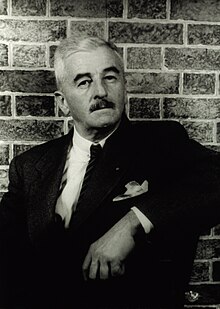
William Cuthbert Faulkner ( September 25, 1897 – July 6, 1962) was an American writer and Nobel Prize laureate from Oxford, Mississippi. Faulkner wrote novels, short stories, a play, poetry, essays, and screenplays. He is primarily known for his novels and short stories set in the fictional Yoknapatawpha County, based on Lafayette County, Mississippi, where he spent most of his life.
His first short story collection, These 13 (1931), includes many of his most acclaimed (and most frequently anthologized) stories, including "A Rose for Emily", "Red Leaves", "That Evening Sun", and "Dry September". Faulkner set many of his short stories and novels in Yoknapatawpha County —based on, and nearly geographically identical to, Lafayette County, of which his hometown of Oxford, Mississippi, is the county seat.
 Yoknapatawpha County is a fictional county created by the American author William Faulkner, based upon and inspired by Lafayette County, Mississippi, and its county seat of Oxford, Mississippi. Faulkner would often refer to Yoknapatawpha County as "my apocryphal county". From Sartoris onwards, Faulkner would set all but three of his novels in the county (Pylon, The Wild Palms and A Fable were set elsewhere).
Faulkner added a map of Yoknapatawpha County at the end of Absalom, Absalom! Contemporary scholars are attempting to map the locations of all Faulkner's fiction.
The word Yoknapatawpha is pronounced [jɒknəpəˈtɔfə]. It is derived from two Chickasaw words—Yocona and petopha, meaning "split land." Faulkner claimed to a University of Virginia audience that the compound means "water flows slow through flat land." Yoknapatawpha was the original name for the actual Yocona River, a tributary of the Tallahatchie which runs through the southern part of Lafayette County, of which Oxford is the seat.
Grendel
 Grendel is a 1971 novel by American author John Gardner. It is a retelling of part of the Old English poem Beowulf from the perspective of the antagonist, Grendel. In the novel, Grendel is portrayed as an antihero. The novel deals with finding meaning in the world, the power of literature and myth, and the nature of good and evil.
In a 1973 interview, Gardner said that "In Grendel I wanted to go through the main ideas of Western Civilization – which seemed to me to be about . . . twelve? – and go through them in the voice of the monster, with the story already taken care of, with the various philosophical attitudes (though with Sartre in particular), and see what I could do, see if I could break out". On another occasion he noted that he "us[ed] Grendel to represent Sartre's philosophical position" and that "a lot of Grendel is borrowed from sections of Sartre's Being and Nothingness.
Grendel has become one of Gardner's best known and reviewed works. Several editions of the novel contain pen and ink line drawings of Grendel's head, by Emil Antonucci. Ten years after publication, the novel was adapted into the 1981 animated movie Grendel Grendel Grendel.
*Antihero
An antihero (or antiheroine) is a protagonist who lacks conventional heroic qualities such as idealism, courage, or morality. These individuals often possess dark personality traits such as disagreeableness, dishonesty, and aggressiveness. These characters are usually considered "conspicuously contrary to an archetypal hero."
>> John Gardner

> Beowulf
 Beowulf is an Old English epic poem consisting of 3182 alliterative lines. It is the oldest surviving long poem in Old English and is commonly cited as one of the most important works of Old English literature. It was written in England some time between the 8th and the early 11th century.The author was an anonymous Anglo-Saxon poet, referred to by scholars as the "Beowulf poet".
The poem is set in Scandinavia. Beowulf, a hero of the Geats, comes to the aid of Hrothgar, the king of the Danes, whose mead hall in Heorot has been under attack by a monster known as Grendel. After Beowulf slays him, Grendel's mother attacks the hall and is then also defeated. Victorious, Beowulf goes home to Geatland (Götaland in modern Sweden) and later becomes king of the Geats. After a period of fifty years has passed, Beowulf defeats a dragon, but is fatally wounded in the battle. After his death, his attendants cremate his body and erect a tower on a headland in his memory.
The full poem survives in the manuscript known as the Nowell Codex, located in the British Library. It has no title in the original manuscript, but has become known by the name of the story's protagonist. In 1731, the manuscript was badly damaged by a fire that swept through Ashburnham House in London that had a collection of medieval manuscripts assembled by Sir Robert Bruce Cotton.
* Grendel's mother
Grendel's mother is one of three antagonists (along with Grendel and the dragon) in the anonymous Old English poem Beowulf (c. 700–1000 AD). She is never given a name in the text.
The nature of Grendel's mother in the poem is the subject of ongoing controversy and debate among medieval scholars. This is due to the ambiguity of a few words in Old English which appear in the original Beowulf manuscript. These words, particularly "ides, aglæcwif" (ll.1258a-1259b), appear either in conjunction with Grendel's mother or with her place of dwelling (a lake). Some have a specific significance within the context of Germanic paganism.
The Mental Traveller
The poem is about travelling in the realm of the mind. Blake generalizes here "about the spiritual history of mankind out the experience of his own spiritual history." It can be also understood as a cycle history of relations between society and idea of liberty in the form of a male and female that grow older and younger in opposition to the other experiencing such changes. As a whole, the poem portrays conflicting ideas that make it difficult for the reader to attach to any given viewpoint.
>> William Blake
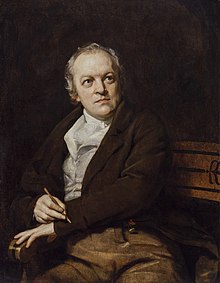 William Blake (28 November 1757 – 12 August 1827) was an English poet, painter, and printmaker. Largely unrecognised during his lifetime, Blake is now considered a seminal figure in the history of the poetry and visual arts of the Romantic Age. His prophetic poetry has been said to form "what is in proportion to its merits the least read body of poetry in the English language". His visual artistry led one contemporary art critic to proclaim him "far and away the greatest artist Britain has ever produced". In 2002, Blake was placed at number 38 in the BBC's poll of the 100 Greatest Britons. Although he lived in London his entire life (except for three years spent in Felpham), he produced a diverse and symbolically rich œuvre, which embraced the imagination as "the body of God" or "human existence itself".
Although Blake was considered mad by contemporaries for his idiosyncratic views, he is held in high regard by later critics for his expressiveness and creativity, and for the philosophical and mystical undercurrents within his work. His paintings and poetry have been characterised as part of the Romantic movement and as "Pre-Romantic". Reverent of the Bible but hostile to the Church of England (indeed, to almost all forms of organised religion), Blake was influenced by the ideals and ambitions of the French and American Revolutions. Though later he rejected many of these political beliefs, he maintained an amiable relationship with the political activist Thomas Paine; he was also influenced by thinkers such as Emanuel Swedenborg. Despite these known influences, the singularity of Blake's work makes him difficult to classify. The 19th-century scholar William Rossetti characterised him as a "glorious luminary", and "a man not forestalled by predecessors, nor to be classed with contemporaries, nor to be replaced by known or readily surmisable successors".
* Church of England

The church dates its establishment to the
6th-century Gregorian mission in Kent led by Augustine of Canterbury. The
English church renounced papal authority when Henry VIII sought to secure an
annulment from Catherine of Aragon in the 1530s. The English Reformation
accelerated under Edward VI's regents before a brief restoration of Catholicism
under Queen Mary I and King Philip. The Act of Supremacy 1558 renewed the
breach and the Elizabethan Settlement charted a course whereby the English
church was to be both Catholic and Reformed:
- Catholic in that it views itself as a part of the universal church of Jesus Christ in unbroken continuity with the early apostolic church. This is expressed in its emphasis on the teachings of the early Church Fathers, as formalised in the Apostles', Nicene, and Athanasian creeds.
- Reformed in that it has been shaped by some of the doctrinal principles of the 16th-century Protestant Reformation, in particular in the Thirty-Nine Articles of Religion and the Book of Common Prayer.
The Canterbury tales

>> Geoffrey Chaucer
.jpg)
While he achieved fame during his lifetime as an author, philosopher, and astronomer, composing a scientific treatise on the astrolabe for his ten-year-old son Lewis, Chaucer also maintained an active career in the civil service as a bureaucrat, courtier and diplomat. Among his many works are The Book of the Duchess, The House of Fame, The Legend of Good Women and Troilus and Criseyde. He is best known today for The Canterbury Tales.
Chaucer was a crucial figure in developing the legitimacy of the vernacular, Middle English, at a time when the dominant literary languages in England were French and Latin.
The Decameron
 The Decameron, subtitled Prince Galehaut, is a collection of novellas by the 14th-century Italian author Giovanni Boccaccio (1313–1375). The book is structured as a frame story containing 100 tales told by a group of seven young women and three young men sheltering in a secluded villa just outside Florence to escape the Black Death, which was afflicting the city. Boccaccio probably conceived the Decameron after the epidemic of 1348, and completed it by 1353. The various tales of love in The Decameron range from the erotic to the tragic. Tales of wit, practical jokes, and life lessons contribute to the mosaic. In addition to its literary value and widespread influence (for example on Chaucer's The Canterbury Tales), it provides a document of life at the time. Written in the vernacular of the Florentine language, it is considered a masterpiece of classical early Italian prose.
>> Giovanni Boccaccio

Tess of the d'Urbervilla


