2016年3月6日 星期日

Approaches to Literature(Week2)


  • Ode on a Grecian Urn

"Ode on a Grecian Urn" is a poem written by the English Romantic poet John Keats in May 1819 and published anonymously in the January 1820, Number 15 issue of the magazine Annals of the Fine Arts (see 1820 in poetry).

Divided into five stanzas of ten lines each, the ode contains a narrator's discourse on a series of designs on a Grecian urn. The poem focuses on two scenes: one in which a lover eternally pursues a beloved without fulfilment, and another of villagers about to perform a sacrifice. The final lines of the poem declare that "'beauty is truth, truth beauty,' – that is all / Ye know on earth, and all ye need to know", and literary critics have debated whether they increase or diminish the overall beauty of the poem. Critics have focused on other aspects of the poem, including the role of the narrator, the inspirational qualities of real-world objects, and the paradoxical relationship between the poem's world and reality.

>> John Keats
John Keats (31 October 1795 – 23 February 1821) was an English Romantic poet. He was one of the main figures of the second generation of Romantic poets, along with Lord Byron and Percy Bysshe Shelley, despite his work having been in publication for only four years before his death.
Although his poems were not generally well received by critics during his lifetime, his reputation grew after his death, and by the end of the 19th century, he had become one of the most beloved of all English poets. He had a significant influence on a diverse range of poets and writers. Jorge Luis Borges stated that his first encounter with Keats was the most significant literary experience of his life.
  • Catharsis

Catharsis (from Greek  meaning "purification" or "cleansing") is the purification and purgation of emotions—especially pity and fear—through art or any extreme change in emotion that results in renewal and restoration. It is a metaphor originally used by Aristotle in the Poetics, comparing the effects of tragedy on the mind of spectator to the effect of a cathartic on the body.

  • Allegory

As a literary device, an allegory in its most general sense is an extended metaphor. Allegory has been used widely throughout history in all forms of art, largely because it can readily illustrate complex ideas and concepts in ways that are comprehensible or striking to its viewers, readers, or listeners.
Writers or speakers typically use allegories as literary devices or as rhetorical devices that convey hidden meanings through symbolic figures, actions, imagery, and/or events, which together create the moral, spiritual, or political meaning the author wishes to convey.
One of the best-known examples of allegory, Plato's Allegory of the Cave, forms a part of his larger work The Republic.

>>Aesop's fable
A collection of fables credited to Aesop, a slave and storyteller believed to have lived in ancient Greece between 620 and 560 BC. Of diverse origins, the stories associated with Aesop's name have descended to modern times through a number of sources. They continue to be reinterpreted in different verbal registers and in popular as well as artistic media.

In Classical times there were various theorists who tried to differentiate these fables from other kinds of narration. They had to be short and unaffected; in addition, they are fictitious, useful to life and true to nature. In them could be found talking animals and plants, although humans interacting only with humans figure in a few. Typically they might begin with a contextual introduction, followed by the story, often with the moral underlined at the end. Setting the context was often necessary as a guide to the story's interpretation, as in the case of the political meaning of The Frogs Who Desired a King and The Frogs and the Sun.

>>Parable
A parable is a succinct, didactic story, in prose or verse, which illustrates one or more instructive lessons or principles. It differs from a fable in that fables employ animals, plants, inanimate objects, or forces of nature as characters, whereas parables have human characters. A parable is a type of analogy.
Some scholars of the canonical gospels and the New Testament apply the term "parable" only to the parables of Jesus,  though that is not a common restriction of the term. Parables such as "The Prodigal Son" are central to Jesus' teaching method in the canonical narratives and the apocrypha.


literary device by which an author hints what is to come. It is used to avoid disappointment. It is also sometimes used to arouse the reader.A hint that is designed to mislead the audience is referred to as a red herring. A similar device is the flashforward (also known as prolepsis). However, foreshadowing only hints at a possible outcome within the confinement of a narrative. A flashforward is a scene that takes the narrative forward in time from the current point of the story in literature, film, television, and other media. Foreshadowing is sometimes employed through characters explicitly predicting the future.By analogy to foreshadowing, the literary critic Gary Morson described its opposite, sideshadowing.


  • Falshback

A flashback is an interjected scene that takes the narrative back in time from the current point in the story. Flashbacks are often used to recount events that happened before the story's primary sequence of events to fill in crucial backstory. In the opposite direction, a flashforward (or prolepsis) reveals events that will occur in the future.Both flashback and flashforward are used to cohere a story, develop a character, or add structure to the narrative. In literature, internal analepsis is a flashback to an earlier point in the narrative; external analepsis is a flashback to a time before the narrative started.
In movies and television, several camera techniques and special effects have evolved to alert the viewer that the action shown is a flashback or flashforward; for example, the edges of the picture may be deliberately blurred, photography may be jarring or choppy, or unusual coloration or sepia tone, or monochrome when most of the story is in full color, may be used.

Prefix/Root/Surffix

ver-/vir- "true"

verism (n.) the theory that rigid representation of truth and reality is essential to art and literature, and therefore the ugly and vulgar must be included 
example: Marisa Miller is a artist of verism.


virtual (a.) having the essence or effect but not the appearance or form of
example: My brother is a virtual reality player.


-dic- "to say, to tell"

verdict (v.) a judgment; decision
example: My wife's verdict on my cooking was very favourable.

predict (v.) to declare or tell in advance; prophesy; foretell
example: He predicted a good harvest.


pro- "in favor of"

protagonist (n.) the leading character, hero, or heroine of a drama or other literary work
example: Lena is a protagonist of this drama.

anti- "against"

antinomy (n.) opposition between one law, principle, rule
example: We have already discussed this subject in the antinomy of pure reason.

antihero (n.) a central character in a novel, play, etc, who lacks the traditional heroic virtues
example: There are always an antihero in each story.

hypo- "under"
hypothesis (n.) a proposition assumed as a premise in an argument
example: No serious arguments that dispute this hypothesis have been advanced.

2016年3月5日 星期六

Approaches to Literature(Week1)

  • Course Syllabus

  • Textbook 

  • The Norton Introduction to Literature

    book cover
     
  • Orientation
  • Genre
    - Critical
    - Approach
    - History

>>Genre

Genre is any category of literature, music, or other forms of art or entertainment, whether written or spoken, audio or visual, based on some set of stylistic criteria. Genres form by conventions that change over time as new genres are invented and the use of old ones is discontinued. Often, works fit into multiple genres by way of borrowing and recombining these conventions.

Genre began as an absolute classification system for ancient Greek literature. Poetry, prose, and performance each had a specific and calculated style that related to the theme of the story. Speech patterns for comedy would not be appropriate for tragedy, and even actors were restricted to their genre under the assumption that a type of person could tell one type of story best.

- Fiction
Fiction is the classification for any story created by the imagination, rather than based strictly on history or fact. Fiction can be expressed in a variety of formats, including writings, live performances, films, television programs, video games, and role-playing games, though the term originally and most commonly refers to the major narrative forms of literature (see literary fiction), including the novel, novella, short story, and play.
 Fiction constitutes an act of creative invention, so that faithfulness to reality is not typically assumed;in other words, fiction is not expected to present only characters who are actual people or descriptions that are factually true. The context of fiction is generally open to interpretation, due to fiction's freedom from any necessary embedding in reality.

- Poetry

>> epic poetry(narrative poetry)
Epic is a lengthy narrative poem, ordinarily concerning a serious subject containing details of heroic deeds and events significant to a culture or nation. Milman Parry and Albert Lord have argued that the Homeric epics, the earliest works of Western literature, were fundamentally an oral poetic form. These works form the basis of the epic genre in Western literature. Nearly all Western epic (including Virgil's Aeneid and Dante's Divine Comedy) self-consciously presents itself as a continuation of the tradition begun by these poems. Classical epic employs dactylic hexameter and recounts a journey, either physical (as typified by Odysseus in the Odyssey) or mental (as typified by Achilles in the Iliad) or both. Epics also tend to highlight cultural norms and to define or call into question cultural values, particularly as they pertain to heroism.

 
>> lyrical poetry
Lyric poetry is a formal type of poetry which expresses personal emotions or feelings, typically spoken in the first person. The term derives from a form of Ancient Greek literature, the lyric, which was defined by its musical accompaniment, usually on a stringed instrument known as a lyre. The term owes its importance in literary theory to the division developed by Aristotle between three broad categories of poetry: lyrical, dramatic and epic

- Drama
Drama is the specific mode of narrative, typically fictional, represented in performance. The term comes from the Greek word δρᾶμα, drama, meaning action, which is derived from the verb δράω, draō, meaning to do or to act. The enactment of drama in theatre, performed by actors on a stage before an audience, presupposes collaborative modes of production and a collective form of reception.

  • Allusion

 Allusion is a figure of speech, in which one refers covertly or indirectly to an object or circumstance from an external context. It is left to the audience to make the connection; where the connection is directly and explicitly stated (as opposed to indirectly implied) by the author, an allusion is instead usually termed a reference. In the arts, a literary allusion puts the alluded text in a new context under which it assumes new meanings and denotations. It is not possible to predetermine the nature of all the new meanings and inter-textual patterns that an allusion will generate. Literary allusion is closely related to parody and pastiche, which are also "text-linking" literary devices.

Example: In Homer, brief allusions could be made to mythic themes of generations previous to the main narrative because they were already familiar to the epic's hearers: one example is the theme of the Calydonian boarhunt. In Hellenistic Alexandria, literary culture and a fixed literary canon known to readers and hearers made a densely allusive poetry effective; the poems of Callimachus offer the best-known examples.

Poem

Shall I compare thee to a summer’s day? (Sonnet 18)

William Shakespeare, 1564 - 1616
Shall I compare thee to a summer’s day?
Thou art more lovely and more temperate.
Rough winds do shake the darling buds of May,
And summer’s lease hath all too short a date.
Sometime too hot the eye of heaven shines,
And often is his gold complexion dimmed;
And every fair from fair sometime declines,
By chance, or nature’s changing course, untrimmed;
But thy eternal summer shall not fade,
Nor lose possession of that fair thou ow’st,
Nor shall death brag thou wand’rest in his shade,
When in eternal lines to Time thou grow’st.
     So long as men can breathe, or eyes can see,
     So long lives this, and this gives life to thee.


2016年1月9日 星期六

English Vocabulary and Etymology(Week18)

Final exam


English Vocabulary and Eytmology(Week17)

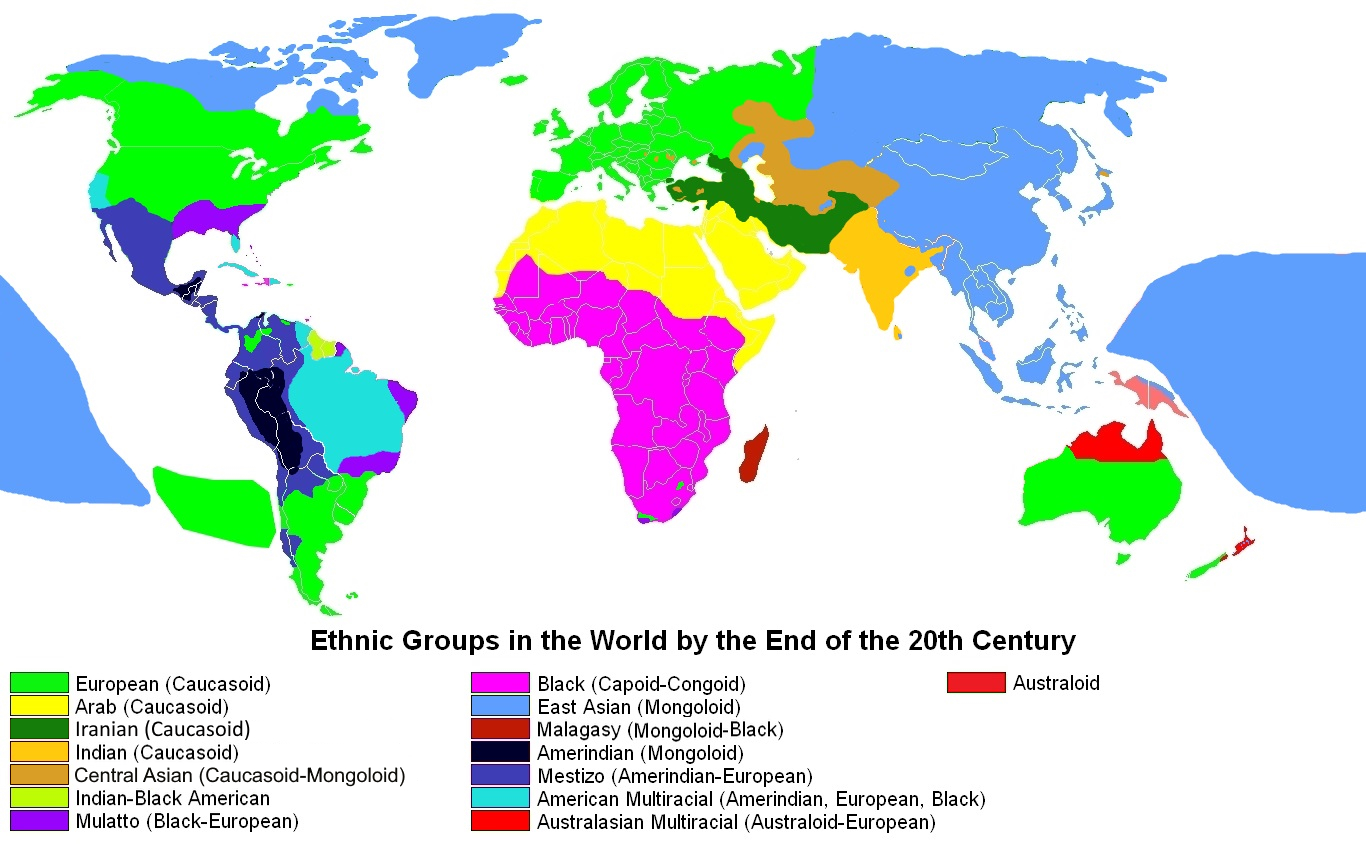
Ethnic group

An ethnic group or ethnicity is a category of people who identify with each other based on common ancestral, social, cultural or national experience. Unlike most other social groups, ethnicity is primarily an inherited status. Membership of an ethnic group tends to be defined by a shared cultural heritage, ancestry, origin myth, history, homeland, language and/or dialect, symbolic systems such as religion, mythology and ritual, cuisine, dressing style, art, and physical appearance.
Ethnic groups, derived from the same historical founder population, often continue to speak related languages and share a similar gene pool. By way of language shift, acculturation, adoption and religious conversion, it is possible for some individuals or groups to leave one ethnic group and become part of another (except for ethnic groups emphasizing racial purity as a key membership criterion).
Ethnicity is often used synonymously with ambiguous terms such as nation or people.

Harriet Tubman

Harriet Tubman by Squyer, NPG, c1885.jpg
An African-American abolitionist, humanitarian, and, during the American Civil War, a Union spy. Born into slavery, Tubman escaped and subsequently made some thirteen missions to rescue approximately seventy enslaved family and friends, using the network of antislavery activists and safe houses known as the Underground Railroad. She later helped abolitionist John Brown recruit men for his raid on Harpers Ferry, and in the post-war era was an active participant in the struggle for women's suffrage.

The History of English


Prefix / Root / Suffix

ab-: away from

abandon (v.) to give up; discontinue; withdraw from
example: The broken bike was found abandoned by the river side.

aboriginal (adj.) original or earliest known; native; indigenous
example: Spence is the leader of an aboriginal community called Attawapiskat in northern Ontario.

ad-: toward

adventure (n.) an exciting or very unusual experience
example: The storm madeour hike a real adventure.

adroit (adj.) cleverly skillful, resourceful, or ingenious
example: He is adroit at making excuses.

Vocabulary

henpeck (v.) to browbeat, bully, or intimidate (one's husband, boyfriend, etc.)
example: My mother always henpecks my father.

checkmate (n.) an act or instance of maneuvering the opponent's king into a check from which it cannot escape, thus bringing the game to a victorious conclusion
example: His efforts to escape met with a checkmate.


English Vocabulary and Etymology(Week16)

Prefix / Root / Suffix

cardi-: heart

cardinal (n.) Roman Catholic Church. a high ecclesiastic appointed by the pope to the College of Cardinals and ranking above every other ecclesiastic but the pope
example: I've had dinner with Bill and Cardinal Smith.

cardiac (adj.) of or relating to the heart
example: Mandy has a cardiac disease.

mega-: big

megalomania (n.) a symptom of mental illness marked by delusions of greatness, wealth, etc
example: The dictator was suffering from megalomania.

megastar (n.) a very well-known personality in the entertainment business
example: Jolin is a megastar in Taiwan.

post-: behind

postdate (v.) to follow in time
example: His recognition as an artist postdated his death.

postpone (v.) to put off to a later time; defer
example: People should postpone private gain to the public welfare.

trans-: across

transcend (v.) to rise above or go beyond; overpass; exceed
example: Human should always transcend their limits.

transcript (n.) a written, typewritten, or printed copy
example: A transcript of the tapes was presented as evidence in court.

nano-: extremely small

nanotechnology (n.) a technology executed on the scale of less than 100 nanometers, the goal of which is to control individual atoms and molecules
example: Nanotechnology bears a special burden.

hyper-: over / beyond

hyperactive (adj.) (of children) displaying exaggerated physical activity sometimes associated with neurologic or psychologic causes
example: He was a slow developer and hyperactive.

hypertension (n.) excessive or extreme emotional tenseness
example: Hypertension is not an unusual occurrence in the PACU.

hypo-: under

hypodermic (adj.) characterized by the introduction of medicine or drugs under the skin
example: He was frightened at seeing the hypodermic needle.

hypocrisy (n.) the practice of professing standards, beliefs, etc, contrary to one's real character or actual behaviour, esp the pretence of virtue and piety
example:  I have no brow of such worldly hypocrisy.

hypochondria (n.) excessive worry or talk about one's health
example: We know the only thing more hopeless than his hypochondria is his romanticism.

ndum-: to be done

referendum (n.) the principle or practice of referring measures proposed or passed by a legislative body to the vote of the electorate for approval or rejection.
example: Many people abstained in the referendum.

memorandum (n.) a short note designating something to be remembered, especially something to be done or acted upon in the future; reminder
example: He sent us a memorandum about the meeting.

Stigma

A term used by members of the Christian faith to describe body marks, sores, or sensations of pain in locations corresponding to the crucifixion wounds of Jesus Christ, such as the hands, wrists, and feet causing extreme pain and torrid affect of humiliation. An individual bearing the wounds of Stigmata is referred to as a Stigmatist.

>>St. Francis of assisi

 An Italian Roman Catholic friar and preacher. He founded the men's Order of Friars Minor, the women’s Order of Saint Clare, the Third Order of Saint Francis and the Custody of the Holy Land. Francis is one of the most venerated religious figures in history.

Pope

 The Bishop of Rome and the leader of the worldwide Catholic Church. The primacy of the Roman bishop is largely derived from his role as the traditional successor to Saint Peter, to whom Jesus is supposed to have given the keys of Heaven and the powers of "binding and loosing", naming him as the "rock" upon which the church would be built. The current pope is Francis, who was elected on 13 March 2013, succeeding Benedict XVI.

>>St. Peter

Pope-peter pprubens.jpgAccording to the New Testament, Saint Peter was one of the Twelve Apostles of Jesus Christ, leaders of the early Christian Church. The Roman Catholic Church considers him to be the first Pope, ordained by Jesus in the "Rock of My Church" dialogue in Matthew 16:18. The ancient Christian churches all venerate Peter as a major saint and associate him with founding the Church of Antioch and later the Church in Rome, but differ about the authority of his various successors in present-day Christianity.

Key of Heaven

In the Gospel of Matthew 16:19, Jesus says to Peter, "I will give you the keys of the kingdom of heaven, and whatever you bind on earth shall be bound in heaven, and whatever you loose on earth shall be loosed in heaven."

>>Pope Benedict XVI

Benedykt XVI (2010-10-17) 4.jpgPope of the Catholic Church from 2005 until his resignation in 2013. On 11 February 2013, Benedict announced his resignation in a speech in Latin before the cardinals, citing a "lack of strength of mind and body" due to his advanced age. His resignation became effective on 28 February 2013. He is the first pope to resign since Pope Gregory XII in 1415, and the first to do so on his own initiative since Pope Celestine V in 1294. As pope emeritus, Benedict retains the style of His Holiness, and the title of Pope, and continues to dress in the papal color of white. He was succeeded by Pope Francis on 13 March 2013, and he moved into the newly renovated Mater Ecclesiae monastery for his retirement on 2 May 2013.

Pope Francis Korea Haemi Castle 19 (cropped).jpg>>Pope Francis

 The 266th and current Pope of the Roman Catholic Church. Following the resignation of Pope Benedict XVI on 28 February 2013. He chose Francis as his papal name in honor of Saint Francis of Assisi. Throughout his public life, Pope Francis has been noted for his humility, emphasis on God's mercy, concern for the poor, and commitment to interfaith dialogue. He is credited with having a humble, less formal approach to the papacy than his predecessors, for instance choosing to reside in the Domus Sanctae Marthae guesthouse rather than in the papal apartments of the Apostolic Palace used by his predecessors.

Stephen Crane

Stephen Crane (November 1, 1871 – June 5, 1900) was an American poet, novelist, and short story writer. Prolific throughout his short life, he wrote notable works in the Realist tradition as well as early examples of American Naturalism and Impressionism. He is recognized by modern critics as one of the most innovative writers of his generation.
The ninth surviving child of Protestant Methodist parents, Crane began writing at the age of four and had published several articles by the age of 16. Having little interest in university studies, he left college in 1891 to work as a reporter and writer. Crane's first novel was the 1893 Bowery tale Maggie: A Girl of the Streets, generally considered by critics to be the first work of American literary Naturalism. He won international acclaim in 1895 for his Civil War novel The Red Badge of Courage, which he wrote without having any battle experience.

The Red Badge of Courage is a war novel by American author Stephen Crane (1871–1900). Taking place during the American Civil War, the story is about a young private of the Union Army, Henry Fleming, who flees from the field of battle. Overcome with shame, he longs for a wound, a "red badge of courage," to counteract his cowardice. When his regiment once again faces the enemy, Henry acts as standard-bearer.

Western Literature(Week18)

Final exam

Western Literature(Week17)

Samon Agonistes

Samson Agonistes is a tragic closet drama by John Milton. It appeared with the publication of Milton's Paradise Regain'd in 1671.

Samson Agonistes draws on the story of Samson from the Old Testament, Judges 13–16; in fact it is a dramatisation of the story starting at Judges 16:23. The drama starts in medias res.The story of Samson in Judges 13–16 portrays a man who was given great strength by God but who ultimately loses his strength when Delilah allows the Philistines to shave his hair during his slumber (Judges 16:19).
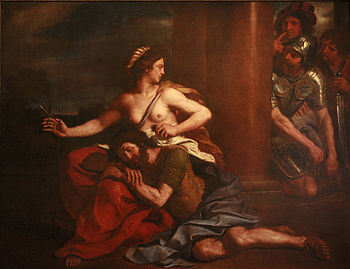
Samson fell in love with a woman named Delilah,  who lived in the valley of Sorek.   The Philistine chiefs called on her,  wanting her to coax from him the secret of his great strength,  and how he might be captured and bound.   "If you do this for us,  we'll each give you eleven hundred silver shekels."
So she asked Samson:  "Tell me where your great strength comes from  -  what it would take to bind you and make you captive."   He replied:  "If I were tied up with seven new bowstrings I'd lose my strength and be like any other man."   The Philistines brought her the bowstrings and she tied him up with them.   She had men hidden in another room,  and she called out:  "The Philistines have come for you,  Samson!"   He snapped the bowstrings just as a thread breaks when fire touches it.   So they remained ignorant of the secret of his strength. She said to him, "Look,  you're playing games with me,  you're lying to me.   Now tell me how you can be tied up."   So he told her,  "If they bind me with new ropes that have never been used,  I'll be as helpless as anybody else."   So Delilah tied him with new ropes.   Then she called out:  "The Philistines have come for you,  Samson!"   And the men were lying in wait in the other room.   But he snapped the ropes off his arms like thread. Delilah said to Samson, "You are still making fun of me,  telling me lies.   Tell me how you can be bound!"   "Well,"  he said,  "if you weave my seven locks of hair into a loom,  and fasten them with a peg,  I'll be as weak as other men."   She soothed him to sleep,  took his locks of hair and wove them into the loom,  and then shouted:  "The Philistines have come for you,  Samson!"   But he woke up and pulled his hair loose.   Delilah said to him,  "How can you say you love me when you obviously don't trust me?   Three times now you have you have made a fool of me!" She kept on at him day after day.   He got so sick of her nagging that in the end he told her the truth"No razor has ever touched my head,  because I have been a Nazirite,  dedicated to God from birth.   If my head were shaved my strength would leave me and I would be no different from others." Delilah realised that this time he had told her the truth.   She summoned the Philistines one more time.   They came bringing the money.   She lulled Samson to sleep in her lap,  and called in a man to cut off his seven locks of hair  -  and his strength left him.   Then she called out:  "The Philistines have come for you,  Samson!"   He awoke from sleep,  imagining he could get loose and escape as always before.   He did not realise that Yahweh had turned away from him.   The Philistines seized him,  gouged out his eyes and took him down to Gaza.   They shackled him with bronze chains,  and put him to work turning the mill in the prison.   But the hair that had been shorn off began to grow again.

* Fatal Woman:Delilah

A femme fatale is a stock character of a mysterious and seductive woman whose charms ensnare her lovers, often leading them into compromising, dangerous, and deadly situations.

Delilah  is a character in the Hebrew bible Book of Judges, where she is the "woman in the valley of Sorek" whom Samson loved, and who was his downfall.

John Milton

John Milton 1.jpg
John Milton (9 December 1608 – 8 November 1674) was an English poet, polemicist, man of letters, and a civil servant for the Commonwealth of England under Oliver Cromwell. He wrote at a time of religious flux and political upheaval, and is best known for his epic poem Paradise Lost (1667), written in blank verse.
Milton's poetry and prose reflect deep personal convictions, a passion for freedom and self-determination, and the urgent issues and political turbulence of his day.


Paradise Lost

Houghton EC65.M6427P.1667aa - Paradise Lost, 1667.jpgParadise Lost is an epic poem in blank verse by the 17th-century English poet John Milton (1608–1674). The first version, published in 1667, consisted of ten books with over ten thousand lines of verse.
The poem concerns the Biblical story of the Fall of Man: the temptation of Adam and Eve by the fallen angel Satan and their expulsion from the Garden of Eden. Milton's purpose, stated in Book I, is to "justify the ways of God to men".


Satan  is a figure appearing in the texts of the Abrahamic religions who brings evil and temptation, and is known as the deceiver who leads humanity astray. Some religious groups teach that he originated as an angel who fell out of favor with God, seducing humanity into the ways of sin, and who has power in the fallen world. In the Hebrew Bible and the New Testament, Satan is primarily an accuser and adversary, a decidedly malevolent entity, also called the devil, who possesses demonic qualities.

Lucifer has become a by-word for Satan/the Devil in the church and in popular literature",  as in Dante Alighieri's Inferno and John Milton's Paradise Lost.

Prince of Darkness is a term used in John Milton's poem Paradise Lost referring to Satan as the embodiment of evil. It is an English translation of the Latin phrase princeps tenebrarum.

Dante Alighieri

head-and-chest side portrait of Dante in red and white coat and cowl
A major Italian poet of the late Middle Ages. His Divine Comedy, originally called Comedìa (modern Italian: Commedia) and later christened Divina by Boccaccio, is widely considered the greatest literary work composed in the Italian language and a masterpiece of world literature.

Divine Comedy
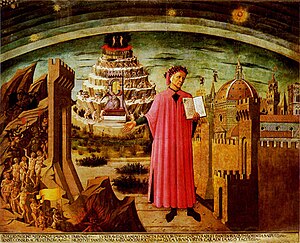
 An epic poem by Dante Alighieri, begun c. 1308 and completed 1320, a year before his death in 1321. It is widely considered the preeminent work of Italian literature and is seen as one of the greatest works of world literature. The poem's imaginative vision of the afterlife is representative of the medieval world-view as it had developed in the Western Church by the 14th century. It helped establish the Tuscan language, in which it is written, as the standardized Italian language. It is divided into three parts: Inferno, Purgatorio, and Paradiso.
On the surface, the poem describes Dante's travels through Hell, Purgatory, and Paradise or Heaven but at a deeper level, it represents, allegorically, the soul's journey towards God. At this deeper level, Dante draws on medieval Christian theology and philosophy, especially Thomistic philosophy and the Summa Theologica of Thomas Aquinas. Consequently, the Divine Comedy has been called "the Summa in verse".

>>Inferno

Inferno is the first part of  Divine Comedy.  It is an allegory telling of the journey of Dante through Hell, guided by the Roman poet Virgil. In the Divine Comedy, Inferno describes the recognition and rejection of sin.
The poem starts on Maundy Thursday in the year 1300. The narrator, Dante himself, is thirty-five years old, and thus "halfway along our life's path"  – half of the Biblical lifespan of seventy The poet finds himself lost in a dark wood  in front of a mountain, assailed by three beasts (a lion, a lonza, and a she-wolf) he cannot evade. Unable to find the "straight way" ( also translatable as "right way") to salvation, he is conscious that he is ruining himself and falling into a "deep place"  where the sun is silent .
Dante is at last rescued by the Roman poet Virgil, who claims to have been sent by Beatrice, and the two of them begin their journey to the underworld. Each sin's punishment in Inferno is a contrapasso, a symbolic instance of poetic justice; for example, fortune-tellers have to walk forward with their heads on backward, unable to see what is ahead, because they tried to see the future through forbidden means. Such a contrapasso "functions not merely as a form of divine revenge, but rather as the fulfilment of a destiny freely chosen by each soul during his or her life."
Dante passes through the gate of Hell, which bears an inscription ending with the famous phrase "Lasciate ogne speranza, voi ch'intrate", most frequently translated as "Abandon all hope, ye who enter here."

Dan Brown

丹·布朗An American author of thriller fiction who is best known for the 2003 bestselling novel The Da Vinci Code.  Brown's novels are treasure hunts set in a 24-hour period,  and feature the recurring themes of cryptography, keys, symbols, codes, and conspiracy theories. His books have been translated into 52 languages, and as of 2012, sold over 200 million copies. Three of them, Angels & Demons (2000), The Da Vinci Code (2003), and Inferno (2013), have been/are being adapted into films.

Inferno is a 2013 mystery thriller novel by American author Dan Brown and the fourth book in his Robert Langdon series.
 The New York Times praised the book as being "jampacked with tricks" and said that Langdon is on "one of those book-length scavenger hunts that Mr. Brown creates so energetically." The New York Daily News reviewed the book favorably, calling it a book of "harrowing fun threaded with coded messages, art history, science, and imminent doom."

>>Purgatorio

Purgatorio is the second part of Dante's Divine Comedy. The poem was written in the early 14th century. It is an allegory telling of the climb of Dante up the Mount of Purgatory, guided by the Roman poet Virgil, except for the last four cantos at which point Beatrice takes over as Dante's guide. In the poem, Purgatory is depicted as a mountain in the Southern Hemisphere, consisting of a bottom section (Ante-Purgatory), seven levels of suffering and spiritual growth (associated with the seven deadly sins), and finally the Earthly Paradise at the top. Allegorically, the poem represents the Christian life, and in describing the climb Dante discusses the nature of sin, examples of vice and virtue, as well as moral issues in politics and in the Church. The poem outlines a theory that all sin arises from love – either perverted love directed towards others' harm, or deficient love, or the disordered or excessive love of good things.

* Seven deadly sin
A Western religious grouping and classification of vices. The sins have fluctuated over time, the currently recognized list includes pride, greed, lust, envy, gluttony, wrath and sloth. There is a parallel tradition of seven virtues.
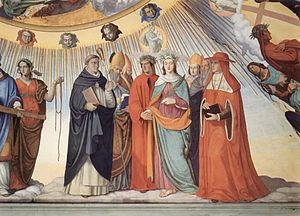
>>Paradiso

Paradiso  is the third and final part of Dante's Divine Comedy. It is an allegory telling of Dante's journey through Heaven, guided by Beatrice, who symbolises theology. In the poem, Paradise is depicted as a series of concentric spheres surrounding the Earth, consisting of the Moon, Mercury, Venus, the Sun, Mars, Jupiter, Saturn, the Fixed Stars, the Primum Mobile and finally, the Empyrean. It was written in the early 14th century. Allegorically, the poem represents the soul's ascent to God.

Book of Exodus
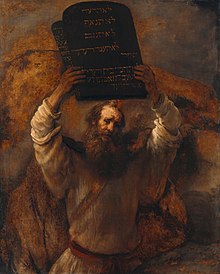
Moses

Rembrandt - Moses with the Ten Commandments - Google Art Project.jpgMoses was born in a time when his people, the Israelites, an enslaved minority, were increasing in numbers and the Egyptian Pharaoh was worried that they might ally with Egypt's enemies. Moses' Hebrew mother, Jochebed, secretly hid him when the Pharaoh ordered all newborn Hebrew boys to be killed in order to reduce the population of the Israelites. Through the Pharaoh's daughter (identified as Queen Bithia in the Midrash), the child was adopted as a foundling from the Nile river and grew up with the Egyptian royal family. After killing an Egyptian slavemaster (because the slavemaster was smiting a Hebrew), Moses fled across the Red Sea to Midian, where he encountered the God of Israel speaking to him from within a "burning bush which was not consumed by the fire" on Mount Horeb (which he regarded as the Mountain of God).
God sent Moses back to Egypt to demand the release of the Israelites from slavery. Moses said that he could not speak with assurance or eloquence, so God allowed Aaron, his brother, to become his spokesperson. After the Ten Plagues, Moses led the Exodus of the Israelites out of Egypt and across the Red Sea, after which they based themselves at Mount Sinai, where Moses received the Ten Commandments. After 40 years of wandering in the desert, Moses died within sight of the Promised Land.

Burning bush

The burning bush is an object described by the Book of Exodus as being located on Mount Horeb. According to the narrative, the bush was on fire, but was not consumed by the flames, hence the name.

 In the biblical narrative, the burning bush is the location at which Moses was appointed by Yahweh (God) to lead the Israelites out of Egypt and into Canaan.
The Hebrew word used in the narrative, that is translated into English as bush, is seneh, which refers in particular to brambles; seneh is a biblical dis legomenon, only appearing in two places, both of which describe the burning bush. It is possible that the reference to a burning bush is based on a mistaken interpretation of Sinai , a mountain described by the Bible as being on fire. Another possibility is that the use of seneh may be a deliberate pun on Sinai , a feature common in Yahwistic texts.
In the narrative, an angel of the Lord is described as appearing in the bush, and God is subsequently described as calling out from it to Moses, who had been grazing Jethro's flocks there. When Moses starts to approach, God tells Moses to take off his sandals first, due to the place being holy ground, and Moses hides his face.

Plagues of Egypt

The Plagues of Egypt, also called the ten biblical plagues, were ten calamities that, according to the biblical Book of Exodus, the God of Israel inflicted upon Egypt to persuade the Pharaoh to release the ill-treated Israelites from slavery. Pharaoh capitulated after the tenth plague, triggering the Exodus of the Hebrew people. The plagues served to contrast the power of the God of Israel with the Egyptian gods, invalidating them. Some commentators have associated several of the plagues with judgment on specific gods associated with the Nile, fertility and natural phenomena. According to Exodus 12:12, all the gods of Egypt would be judged through the tenth and final plague: "On that same night I will pass through Egypt and strike down every firstborn of both people and animals, and I will bring judgment on all the gods of Egypt. I am the LORD."
The first three plagues seemed to affect "all the land of Egypt", while the 4th, 5th, 6th, 7th, and 9th did not affect the children of Israel. Conditions of the 8th plague are unclear. For the last plague, the Torah indicates that they were only spared from the final plague by sacrificing the Paschal lamb, marking their place directly above their doors with the lamb's blood, and eating the roasted sacrifice together with Matzot  in a celebratory feast. The Torah describes God as actually passing through Egypt to kill all firstborn children and cattle, but passing over (hence "Passover") houses which have the sign of lambs' blood on the doorpost. It is debated whether it was actually God who came through the streets or one of his angels. Some also think it may be the Holy Spirit. It is most commonly known as the "Angel of Death". The night of this plague, Pharaoh finally relents and sends the Israelites away under their terms.

Manna

Tissot The Gathering of the Manna (color).jpg
An edible substance that, according to the Bible and the Qura, God provided for the Israelites during their travels in the desert.
 In the Hebrew Bible, manna is described twice: once in Exodus 16:1-36 with the full narrative surrounding it, and once again in Numbers 11:1-9as a part of a separate narrative.In the description in the Book of Exodus, manna is described as being "a fine, flake-like thing" like the frost on the ground. Exodus adds that manna was comparable to hoarfrost in size, similarly had to be collected before it was melted by the heat of the sun, and was white like coriander seed.

Passover

An important, biblically derived Jewish festival. The Jewish people celebrate Passover as a commemoration of their liberation by God from slavery in Egypt and their freedom as a nation under the leadership of Moses. It commemorates the story of the Exodus as described in the Hebrew Bible especially in the Book of Exodus, in which the Israelites were freed from slavery in Egypt. According to standard biblical chronology, this event would have taken place at about 1300 BCE

Ten Commandment

The Ten Commandments, also known as the Decalogue, are a set of commandments which the Bible describes as having been given to the Israelites by God at biblical Mount Sinai. The Ten Commandments are listed twice in the Hebrew Bible, first at Exodus 20:1–17, and then at Deuteronomy 5:4–21. Both versions state that God inscribed them on two stone tablets, which he gave to Moses. According to New Testament writers, the Ten Commandments are clearly attributed to Moses (Mark 7:10, see also John 7:19).
Modern scholarship has found likely influences in Hittite and Mesopotamian laws and treaties, but is divided over exactly when the Ten Commandments were written and who wrote them.
The commandments include instructions to worship only God, to honour parents, and to keep the sabbath; as well as prohibitions against idolatry, blasphemy, murder, adultery, theft, dishonesty, and coveting. Different religious groups follow different traditions for interpreting and numbering them.

Allegory / Fable / Parable


Allegory
As a literary device, an allegory in its most general sense is an extended metaphor.Writers or speakers typically use allegories as literary devices or as rhetorical devices that convey hidden meanings through symbolic figures, actions, imagery, and/or events, which together create the moral, spiritual, or political meaning the author wishes to convey.
One of the best-known examples of allegory, Plato's Allegory of the Cave, forms a part of his larger work The Republic.

Fable
A literary genre: a succinct fictional story, in prose or verse, that features animals, mythical creatures, plants, inanimate objects, or forces of nature that are anthropomorphized (given human qualities, such as verbal communication) and that illustrates or leads to an interpretation of a moral lesson (a "moral"), which may at the end be added explicitly as a pithy maxim.

Parable
A succinct, didactic story, in prose or verse, which illustrates one or more instructive lessons or principles. It differs from a fable in that fables employ animals, plants, inanimate objects, or forces of nature as characters, whereas parables have human characters. A parable is a type of analogy.

para-: side by side

parallel (v.) be equivalent to
example: They  parallel with  one another.

paragraph (n.) a distinct portion of written or printed matter dealing with a particular idea, usually beginning with an indentation on a new line
example: Don't omit this paragraph when you write your report.

parasol (n.) a lightweight umbrella used, especially by women, as a sunshade
example: Cindy bought a pretty parasol for me.

parachute (n.) a folding, umbrellalike, fabric device with cords supporting a harness or straps for allowing a person, object, package, etc., to float down safely through the air from a great height
example: When his parachute failed he thought he was a goner.